Solution:
Concept: Total internal reflection: it happens only when light goes from a denser to a rarer medium and the angle of incidence is greater than the critical angle. Then no light is refracted out; all of it is reflected back, obeying the laws of reflection (angle of reflection = angle of incidence).
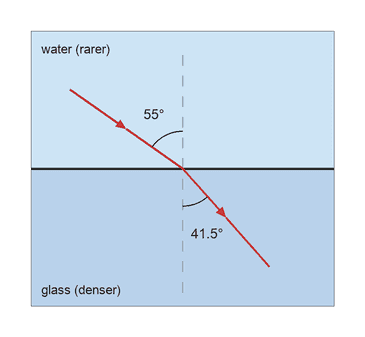
Given: A ray goes from water into glass at an angle of incidence of 55°; critical angle for glass–water 54°.
Step 1 — Identify the direction of travel.
The ray goes from water (rarer) into glass (denser). Glass is optically denser than water.
Step 2 — Apply the condition for total internal reflection.
Total internal reflection can happen only when light goes from a denser to a rarer medium. Going from water into glass, the ray bends towards the normal, so a refracted ray always exists, however large the angle of incidence.
Step 3 — Explain why 55° and 54° are not compared.
The critical angle of 54° applies to light going the other way, from glass into water. So comparing 55° with 54° does not apply here.
Step 4 — Find the actual angle of refraction.
For the glass–water pair, sin 54° = μ(water)/μ(glass). Going from water into glass, Snell's law gives sin r = sin 55° × sin 54°:
sinr=sin55∘×sin54∘≈0.663
r=41.5∘
Watch out: Total internal reflection needs light going from the denser to the rarer medium; a large angle alone is not enough.
Therefore, no, the ray does not undergo total internal reflection: it is going from a rarer medium (water) into a denser medium (glass), so it simply refracts into the glass (at about 41.5°), bending towards the normal.
