Solution:
Concept: A ray that meets a surface along the normal (angle of incidence 0°) passes into the next medium without bending (angle of refraction 0°). Total internal reflection: it happens only when light goes from a denser to a rarer medium and the angle of incidence is greater than the critical angle. Then no light is refracted out; all of it is reflected back, obeying the laws of reflection (angle of reflection = angle of incidence).
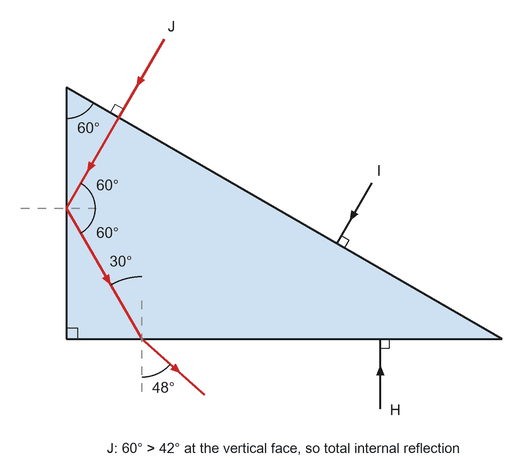
Given: A 30°–60°–90° prism; rays I, J (normal to the slant face) and H (normal to the base); critical angle 42°.
Step 1 — Part (a): ray J.
J enters the slant face normally, so it goes straight in, perpendicular to the slant face. Near the top it reaches the vertical face first. The angle of incidence there equals the angle between the slant face and the vertical face, 60°, which is greater than 42°, so J is totally reflected.
Step 2 — Part (a): rays I and H.
Ray I (normal to the slant face) reaches the base, and ray H (normal to the base) reaches the slant face. In each case the angle of incidence equals the 30° angle between those two faces, which is less than 42°, so I and H simply refract out.
Step 3 — Part (b): path of J at the base.
After reflection at the vertical face (angle of reflection 60°), J travels down to the base and meets it at an angle of incidence of 30°. As 30° < 42°, it refracts out into air, bending away from the normal:
sine=sin42∘sin30∘≈0.747
e=48∘
Watch out: Angles of incidence and refraction are measured from the normal; if a figure gives the angle with the surface, subtract it from 90°.
Therefore, (a) ray J suffers total internal reflection (at the vertical face, i = 60°); (b) J enters undeviated, is totally reflected at the vertical face and refracts out through the base (i = 30°), bending away from the normal at about 48°.

