Solution:
Concept: Real and apparent depth: an object inside a denser medium, seen from above (nearly along the normal), appears raised, because rays from it bend away from the normal on coming out. μ=apparent depthreal depth, and the shift (apparent rise) is real depth − apparent depth. Refractive index and colour: in glass or water, light of shorter wavelength travels more slowly, so the refractive index is larger for violet and blue light and smallest for red light (order: red < orange < yellow < green < blue < indigo < violet).
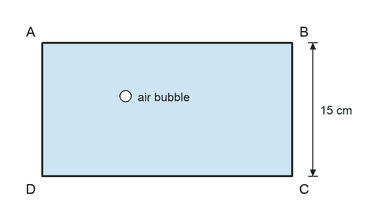
Given: Μ = 1.5; block 15 cm thick; seen from AB the bubble appears 4 cm deep.
Step 1 — Part (a): write the relation.
Seen from AB, μ = real depth ÷ apparent depth, so
real depth=μ×apparent depth
Step 2 — Part (a): put in the values.
We substitute μ = 1.5 and apparent depth = 4 cm:
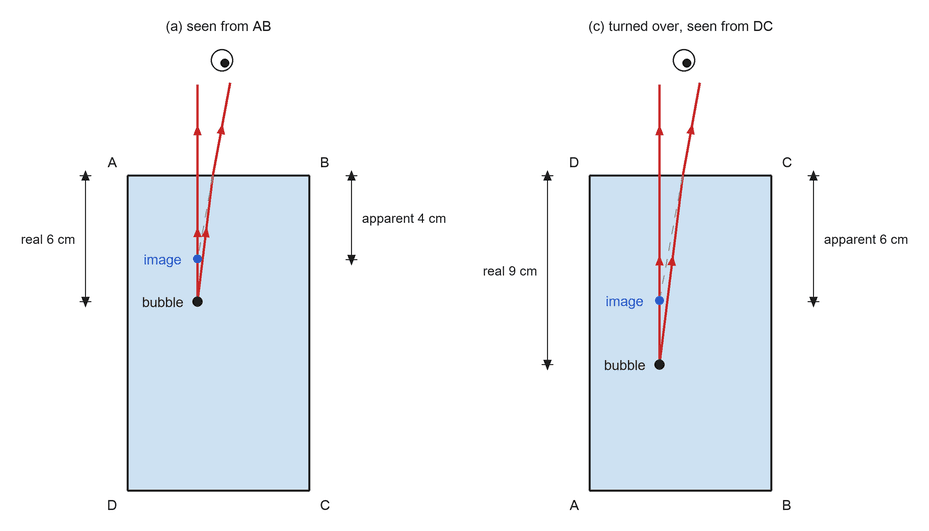
real depth=1.5×4=6 cm
Step 3 — Part (b): blue or yellow.
The refractive index of glass is less for yellow light than for blue light. Since apparent depth = real depth ÷ μ, a smaller μ gives a greater apparent depth. So the apparent depth is greater for yellow light.
Step 4 — Part (c): turn the block over.
Seen from DC, the bubble's real depth is measured from DC instead:
real depth from DC=15−6=9 cm
apparent depth=1.59=6 cm
This is 6 cm, not 4 cm, so the statement is false: the bubble is not at the middle of the block.
Watch out: After turning the block over, measure the real depth from the NEW top face DC (15 − 6 = 9 cm).
Therefore, (a) the bubble is 6 cm below AB; (b) yellow light; (c) false (from DC it appears 6 cm deep).