Solution:
Concept: Refraction: light bends when it passes obliquely from one medium into another because its speed changes. Going into an optically denser medium it bends towards the normal; going into a rarer medium it bends away from the normal. Snell's law: sinrsini is a constant (the refractive index) for a given pair of media and a given colour of light. All angles are measured from the normal, not from the surface. Refractive index and colour: in glass or water, light of shorter wavelength travels more slowly, so the refractive index is larger for violet and blue light and smallest for red light (order: red < orange < yellow < green < blue < indigo < violet). Refractive index and speed: μ=vc, where c is the speed of light in vacuum (or air) and v its speed in the medium. Light is slower in a medium of larger refractive index.
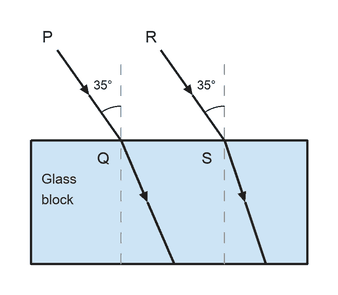
Given: Rays PQ and RS fall on a glass block at 35°; RS bends more inside.
Step 1 — Read the figure.
Both rays meet the block at the same angle of incidence, 35°, but RS bends closer to the normal inside the block (smaller angle of refraction). So the glass has a larger refractive index for RS: RS is light nearer the violet end, PQ nearer the red end.
Step 2 — Part (a): greater lateral displacement.
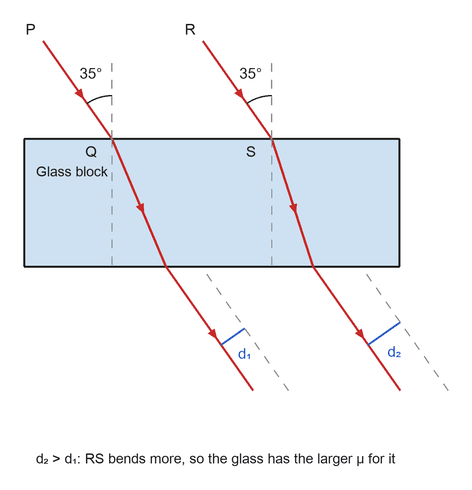
For the same block and the same angle of incidence, the ray that bends more is shifted sideways more. So RS has the greater lateral displacement (d₂ > d₁).
Step 3 — Part (b): greater speed in the block.
Since μ = c/v, the smaller refractive index goes with the larger speed. PQ bends less, so PQ travels faster in the block.
Step 4 — Part (c): more scattering in the atmosphere.
A larger refractive index means a shorter wavelength (towards blue–violet), and shorter wavelengths are scattered more. So RS scatters more.
Watch out: Judge each ray by how much it bends at the SAME angle of incidence; the ray that bends more has the larger μ.
Therefore, (a) RS; (b) PQ; (c) RS.