
Question 401 markMCQAsked 2025Medium
Which of the following figures will depict deviation of a ray of light through 90° when it emerges out of the prism.
Confirming your payment
Sign up now and get 250 free tokens.
Previous Year Questions · Question 40 of 57
Which of the following figures will depict deviation of a ray of light through 90° when it emerges out of the prism.
(A) 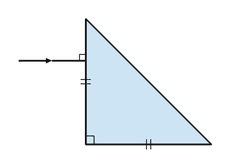
(B) 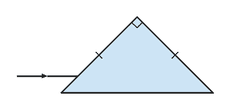
(C) 
(D) 
Answer: (A)
Concept: A right-angled isosceles prism (angles 90°, 45°, 45°) of glass (critical angle about 42°) can act as a perfect mirror: a ray entering a face normally meets the next face at 45°, which is more than 42°, so it is totally reflected.
Step 1 — Figure (A).
The ray enters a short face of the right-angled isosceles prism normally and goes straight on. It meets the hypotenuse at 45°, more than the critical angle of glass (about 42°), so it is totally reflected and turned through 180° − 2 × 45° = 90°. It leaves the other short face normally.
Step 2 — Check the other figures.
Tracing each of the other three figures (below) gives deviations of 0°, 180° and about 19°, so only (A) turns the ray through 90°.
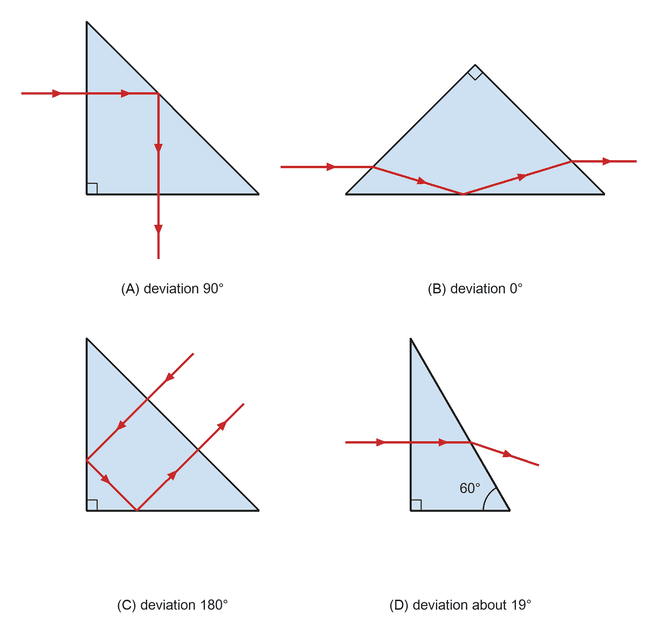
Watch out: A 90° turn needs the ray to meet the hypotenuse at 45° after entering a short face normally.
Why the other options are wrong:
Therefore, figure (A) shows the ray deviated through 90°, option (A).