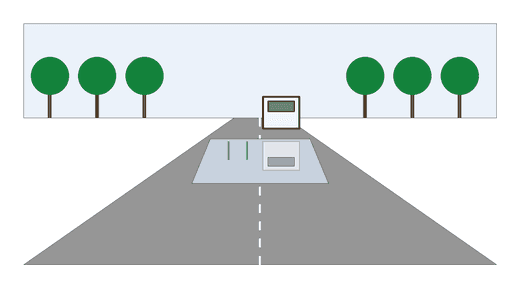
Solution:
Concept: Total internal reflection: it happens only when light goes from a denser to a rarer medium and the angle of incidence is greater than the critical angle. Then no light is refracted out; all of it is reflected back, obeying the laws of reflection (angle of reflection = angle of incidence).
Step 1 — Part (a): name the phenomenon.
The phenomenon is mirage.
Step 2 — Part (a): define it.
A mirage is an optical illusion in which a distant object (a vehicle, a tree, the sky) is seen together with its inverted image below it, as if reflected from a pool of water, so the road ahead looks wet. It is caused by total internal reflection of light at the hot, rarer layers of air near the ground.
Step 3 — Part (a): explain how it happens.
On a hot afternoon the air just above the road is much hotter, and so optically rarer, than the air above it. A ray from the top of an object going downwards passes into hotter and hotter layers and bends away from the normal at each one. Near the road its angle of incidence becomes greater than the critical angle, so it is totally reflected and travels up into the driver's eye. The eye sees the light as coming from below the road.

Step 4 — Part (b): another example.
The mirage seen in a desert: on a hot sunny day a traveller sees what looks like a pool of water with inverted images of distant trees.
Watch out: A mirage is not a reflection from real water; the 'water' is an image of the sky formed by total internal reflection in hot air.
Therefore, (a) mirage: an illusion of water with inverted images of distant objects, caused by total internal reflection of light in the hot, rarer air near the ground; (b) the mirage seen in a desert.