Solution:
Concept: Refractive index and speed: μ=vc, where c is the speed of light in vacuum (or air) and v its speed in the medium. Light is slower in a medium of larger refractive index. Refraction: light bends when it passes obliquely from one medium into another because its speed changes. Going into an optically denser medium it bends towards the normal; going into a rarer medium it bends away from the normal. Snell's law: sinrsini is a constant (the refractive index) for a given pair of media and a given colour of light. All angles are measured from the normal, not from the surface.
Given: Speed of light in water 2.25×10⁸ m s⁻¹, in kerosene oil 2.15×10⁸ m s⁻¹.
Step 1 — Part (a): compare the speeds.
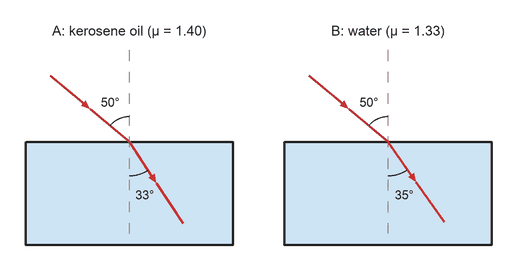
Light is faster in water (2.25×10⁸ m s⁻¹) than in kerosene oil (2.15×10⁸ m s⁻¹). By μ = c/v, water has the smaller refractive index, so it bends light less and the angle of refraction is more in water (beaker B).
Step 2 — Part (b): write the ratio.
Since μ = c/v, the ratio of refractive indices is the inverse ratio of the speeds:
μkμw=vwvk
Step 3 — Part (b): put in the values.
We substitute the two speeds; the powers of ten cancel:
μkμw=2.25×1082.15×108=4543
μkμw=4543≈0.96
Step 4 — Part (c): heating the kerosene.
Heating lowers the refractive index of kerosene. The ray then bends less towards the normal, so the angle of refraction increases: the refracted ray moves away from the normal.
Watch out: The liquid in which light is FASTER has the smaller μ and the LARGER angle of refraction.
Therefore, (a) in water (beaker B); (b) μ(water) : μ(kerosene) = 43 : 45, about 0.96; (c) the angle of refraction increases (the refracted ray moves away from the normal).
