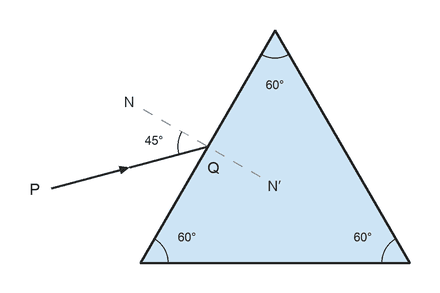
Solution:
Concept: Minimum deviation: as the angle of incidence increases, the deviation first decreases, reaches a least value δmin, then increases. At minimum deviation the ray passes symmetrically: the ray inside is parallel to the base, r1 and r2 are equal (each is 2A), and the angle of emergence equals the angle of incidence. Prism: for a prism of angle A, the angle of deviation is δ=i1+i2−A, where i1 is the angle of incidence and i2 the angle of emergence. Inside, the angles of refraction at the two faces satisfy r1+r2=A.
Given: Equilateral prism at minimum deviation; angle of incidence 45°.
Step 1 — Part (a): the ray inside.
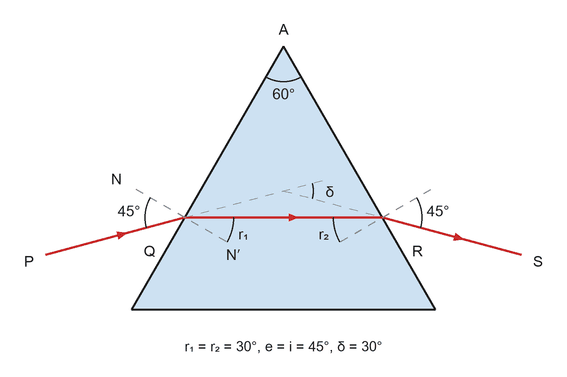
At minimum deviation the path is symmetrical. For an equilateral prism (A = 60°) the angle of refraction at Q is
r1=2A=260∘=30∘
So the ray bends towards the normal at Q and travels inside parallel to the base.
Step 2 — Part (a): the emergent ray.
At R the ray meets the second face at r2=30∘, bends away from the normal and emerges at an angle of emergence equal to the angle of incidence, 45°.
Step 3 — Part (a): the deviation.
The angle of (minimum) deviation is
δ=i+e−A=45∘+45∘−60∘=30∘
For this to happen, the refractive index of the prism must be sin 45° ÷ sin 30° = √2 ≈ 1.41.
Step 4 — Part (b): factors on which the deviation depends.
The angle of deviation depends on: (1) the angle of incidence; (2) the material of the prism (its refractive index). It also depends on the angle of the prism and on the colour (wavelength) of the light.
Watch out: At minimum deviation the angle of emergence equals the angle of incidence (45°), not the angle of refraction (30°).
Therefore, (a) the ray refracts at Q to r₁ = 30°, travels parallel to the base, and emerges at R at e = 45° (deviation 30°); (b) the angle of incidence and the refractive index (material) of the prism.