
Question 331 markMCQAsked 2025Easy
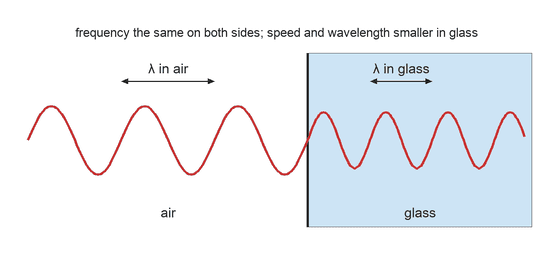
When a ray of light passes from one optical medium to another, which of the following physical quantities does NOT change?
Confirming your payment
Sign up now and get 250 free tokens.
Previous Year Questions · Question 33 of 57
When a ray of light passes from one optical medium to another, which of the following physical quantities does NOT change?
(A) Amplitude of the wave
(B) Frequency of the wave
(C) Wavelength of the wave
(D) Speed of the wave
Answer: (B) Frequency of the wave
Concept: Speed, frequency and wavelength are linked by . On refraction the speed changes, the frequency stays the same (it is set by the source), so the wavelength changes.
Step 1 — What fixes the frequency.
The frequency of light is the number of waves the source sends out each second. The boundary cannot create or destroy waves, so the same number of waves per second passes into the second medium: the frequency does not change.
Step 2 — What the speed does.
On entering a denser medium, light slows down, so the speed v changes.
Step 3 — What the wavelength does.
Since v = fλ and f stays the same, the wavelength changes in the same ratio as the speed:
Watch out: The colour of light is fixed by its frequency, so it does not change in water or glass even though the wavelength does.
Why the other options are wrong:
Therefore, the frequency of the wave does not change, option (B).