
Question 341 markMCQAsked 2025Medium
A ray of light is incident normally on a face of an equilateral prism.
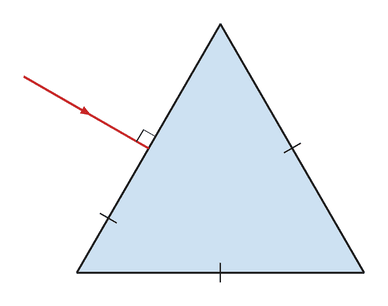
The ray gets totally reflected at the second refracting surface. The total deviation produced in the path of the ray is:
Confirming your payment
Sign up now and get 250 free tokens.
Previous Year Questions · Question 34 of 57
A ray of light is incident normally on a face of an equilateral prism.
The ray gets totally reflected at the second refracting surface. The total deviation produced in the path of the ray is:
(A) 30°
(B) 60°
(C) 90°
(D) 120°
Answer: (B) 60°
Concept: A ray that meets a surface along the normal (angle of incidence 0°) passes into the next medium without bending (angle of refraction 0°). Total internal reflection: it happens only when light goes from a denser to a rarer medium and the angle of incidence is greater than the critical angle. Then no light is refracted out; all of it is reflected back, obeying the laws of reflection (angle of reflection = angle of incidence).
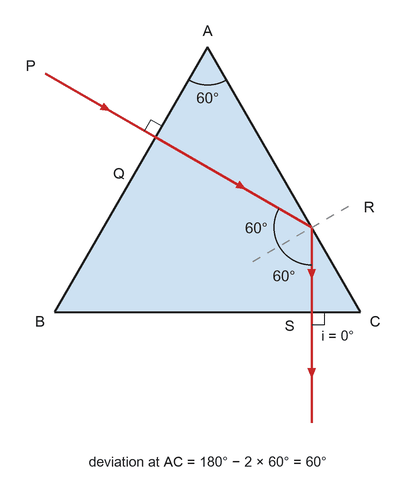
Step 1 — First face.
The ray enters normally (i = 0°), so it is not deviated there.
Step 2 — Angle of incidence at the second face.
The ray inside is perpendicular to the first face, and the normal at the second face is perpendicular to that face. So the angle of incidence equals the angle between the two faces, the prism angle, 60°. As 60° is more than the critical angle of glass (about 42°), the ray is totally reflected.
Step 3 — Deviation on reflection.
A reflection with angle of incidence i turns a ray through 180° − 2i:
Step 4 — Third face.
The reflected ray meets the third face along its normal (i = 0°) and leaves undeviated, so the total deviation stays 60°.
Watch out: The turn produced by a reflection is 180° − 2i, not 2i.
Why the other options are wrong:
Therefore, the total deviation is 60°, option (B).