
Question 22 marksAsked 2016Medium
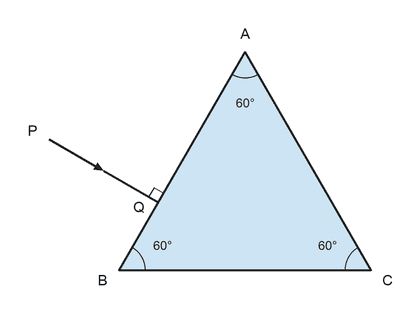
Copy the diagram given below and complete the path of light ray till it emerges out of the prism. The critical angle of glass is 42°. In your diagram mark the angles wherever necessary.
Confirming your payment
Sign up now and get 250 free tokens.
Previous Year Questions · Question 2 of 57
Copy the diagram given below and complete the path of light ray till it emerges out of the prism. The critical angle of glass is 42°. In your diagram mark the angles wherever necessary.
Solution:
Concept: A ray that meets a surface along the normal (angle of incidence 0°) passes into the next medium without bending (angle of refraction 0°). Total internal reflection: it happens only when light goes from a denser to a rarer medium and the angle of incidence is greater than the critical angle. Then no light is refracted out; all of it is reflected back, obeying the laws of reflection (angle of reflection = angle of incidence).
Given: Equilateral prism ABC (each angle 60°), ray PQ normal to AB, critical angle of glass 42°.
Step 1 — At face AB (point Q).
The ray PQ falls normally on AB, so the angle of incidence is 0°. It enters the glass without bending, travelling perpendicular to AB.
Step 2 — Find the angle of incidence at the base BC.
The ray inside is perpendicular to AB, and the normal at R is perpendicular to BC. The angle between two lines equals the angle between their perpendiculars, so the angle of incidence at R equals the angle between AB and BC, which is ∠B:
Step 3 — Decide what happens at R.
The ray is going from glass to air, and its angle of incidence (60°) is greater than the critical angle (42°). So it suffers total internal reflection at R. The angle of reflection is also 60°, on the other side of the normal.
Step 4 — At face AC (point S).
The reflected ray makes 90° − 60° = 30° with BC. In triangle RSC, ∠SRC = 30° and ∠C = 60°, so the third angle is
The ray therefore meets AC along the normal (angle of incidence 0°) and passes out undeviated.

Watch out: Angles of incidence and refraction are measured from the normal; if a figure gives the angle with the surface, subtract it from 90°.
Therefore, the ray enters AB undeviated (i = 0°), is totally internally reflected at BC (i = 60°, more than 42°, reflected at 60°) and emerges normally through AC (i = 0°).