Solution:
Concept: Refractive index and speed: μ=vc, where c is the speed of light in vacuum (or air) and v its speed in the medium. Light is slower in a medium of larger refractive index. Refractive index and colour: in glass or water, light of shorter wavelength travels more slowly, so the refractive index is larger for violet and blue light and smallest for red light (order: red < orange < yellow < green < blue < indigo < violet).
Step 1 — Compare the wavelengths.
Blue light has a shorter wavelength than red light.
Step 2 — Compare the speeds in glass.
In glass, light of shorter wavelength travels more slowly. So blue light moves more slowly through the glass than red light.
Step 3 — Compare the refractive indices.
The refractive index is the speed of light in air divided by its speed in the glass:
μ=vc
A smaller speed v in the glass gives a larger μ. So the glass has a larger refractive index for blue light than for red light.
Step 4 — What the boy observes.
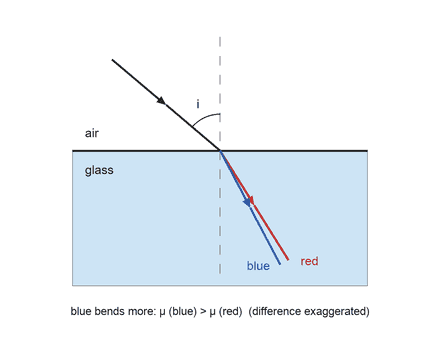
For the same angle of incidence, the blue ray bends more towards the normal, so its angle of refraction is smaller and sinrsini comes out larger for blue light than for red light.
Watch out: The refractive index of a material is not one fixed number; it is always quoted for a particular colour of light.
Therefore, the refractive index will be different: it is greater for blue light than for red light, because blue light (shorter wavelength) travels more slowly in glass and bends more.
