
Question 102 marksAsked 2018Medium
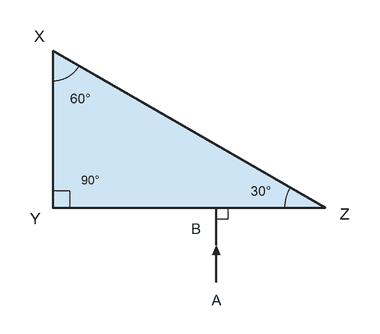
The following diagram shows a 60°, 30°, 90° glass prism of critical angle 42°. Copy the diagram and complete the path of incident ray AB emerging out of the prism marking the angle of incidence on each surface.
Confirming your payment
Sign up now and get 250 free tokens.
Previous Year Questions · Question 10 of 57
The following diagram shows a 60°, 30°, 90° glass prism of critical angle 42°. Copy the diagram and complete the path of incident ray AB emerging out of the prism marking the angle of incidence on each surface.
Solution:
Concept: A ray that meets a surface along the normal (angle of incidence 0°) passes into the next medium without bending (angle of refraction 0°). Critical angle (C): the angle of incidence in the denser medium for which the angle of refraction in the rarer medium is 90°. For glass or water to air, . Total internal reflection: it happens only when light goes from a denser to a rarer medium and the angle of incidence is greater than the critical angle. Then no light is refracted out; all of it is reflected back, obeying the laws of reflection (angle of reflection = angle of incidence).
Given: 60°–30°–90° prism XYZ, ray AB normal to YZ, critical angle 42°.
Step 1 — At face YZ (point B).
The ray AB falls along the normal to YZ, so the angle of incidence is 0° and it goes straight up into the prism without bending.
Step 2 — Find the angle of incidence at XZ.
The ray inside is perpendicular to YZ, and the normal to XZ is perpendicular to XZ. So the angle between the ray and that normal equals the angle between YZ and XZ, which is ∠Z:
Step 3 — Decide what happens at XZ.
The angle of incidence, 30°, is less than the critical angle, 42°. So there is no total internal reflection: the ray refracts out into air, bending away from the normal.
Step 4 — Find the angle of emergence.
With a critical angle of 42°, the refractive index of the glass is
By Snell's law for light leaving the glass, sin e = μ sin i:

Watch out: Angles of incidence and refraction are measured from the normal; if a figure gives the angle with the surface, subtract it from 90°.
Therefore, the ray goes straight through YZ (i = 0°), meets XZ at i = 30° (less than 42°) and refracts out into air, bending away from the normal at about 48°.