Solution:
Concept: A right-angled isosceles prism (angles 90°, 45°, 45°) of glass (critical angle about 42°) can act as a perfect mirror: a ray entering a face normally meets the next face at 45°, which is more than 42°, so it is totally reflected.
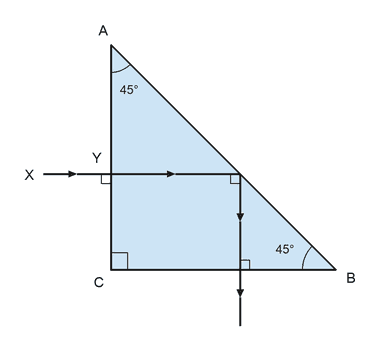
Given: Right-angled isosceles prism, ray XY normal to face AC.
Step 1 — Follow the ray through the prism.
The ray XY enters face AC normally, so it goes straight in. It meets the hypotenuse AB at an angle of incidence of 45° (equal to ∠A). Since 45° is more than the critical angle of glass (about 42°), it is totally reflected, and it then leaves face CB normally.

Step 2 — Part (i): find the deviation.
A reflection with angle of incidence i turns a ray through 180° − 2i:
δ=180∘−2×45∘=90∘
The ray was horizontal and leaves vertically, so it is deviated through 90°.
Step 3 — Part (ii): name the instrument.
This action is used in a periscope: two such prisms each turn the light through 90°, so an observer can see over an obstacle.
Step 4 — Part (iii): the surface acting as a mirror.
The hypotenuse face AB behaves as a mirror, because the light is totally reflected there.
Watch out: The turn on reflection is 180° − 2i, not 2i; here both give 90°, but they differ for other angles.
Therefore, (i) the ray is deviated through 90°; (ii) the periscope; (iii) the hypotenuse face AB acts as a mirror.