
Question 123 marksAsked 2018Medium
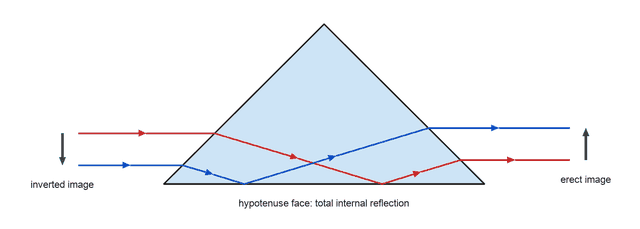
Draw the diagram of a right angled isosceles prism which is used to make an inverted image erect.
Confirming your payment
Sign up now and get 250 free tokens.
Previous Year Questions · Question 12 of 57
Draw the diagram of a right angled isosceles prism which is used to make an inverted image erect.
Solution:
Concept: A right-angled isosceles prism (angles 90°, 45°, 45°) of glass (critical angle about 42°) can act as a perfect mirror: a ray entering a face normally meets the next face at 45°, which is more than 42°, so it is totally reflected.
Step 1 — Place the prism.
Draw a right-angled isosceles prism with its hypotenuse face as the base. Draw two rays from the top and bottom of the inverted image falling on one short face, parallel to the base.
Step 2 — Refraction at the first face.
Each ray meets the slanting face at 45°, refracts into the glass bending towards the normal, and travels down towards the hypotenuse (for glass of μ = 1.5 it slopes down at about 17°).
Step 3 — Total internal reflection at the hypotenuse.
Each ray meets the hypotenuse at an angle of incidence of about 73°, which is greater than 42°, so it is totally reflected upwards.
Step 4 — Emergence from the second face.
The rays refract out of the other short face and travel parallel to their original direction, so there is no deviation.
Step 5 — See why the image becomes erect.
The ray that entered higher leaves lower, and the ray that entered lower leaves higher. The top and bottom are interchanged, so an inverted image becomes erect. A prism used in this way is called an erecting prism.
Watch out: The rays must fall parallel to the hypotenuse (base); entering a short face normally gives a 90° turn instead.
Therefore, a right-angled isosceles prism with its hypotenuse as the base and rays falling parallel to it: the rays are totally reflected at the hypotenuse and leave parallel to their original direction with top and bottom interchanged, so the inverted image becomes erect.