
Question 132 marksAsked 2019Easy
(i) Define critical angle.
(ii) State one important factor which affects the critical angle of a given medium.
Confirming your payment
Sign up now and get 250 free tokens.
Previous Year Questions · Question 13 of 57
(i) Define critical angle.
(ii) State one important factor which affects the critical angle of a given medium.
Solution:
Concept: Critical angle (C): the angle of incidence in the denser medium for which the angle of refraction in the rarer medium is 90°. For glass or water to air, .
Step 1 — Part (i): define the critical angle.
The critical angle is the angle of incidence in the denser medium for which the angle of refraction in the rarer medium is 90°, so that the refracted ray just grazes the surface.
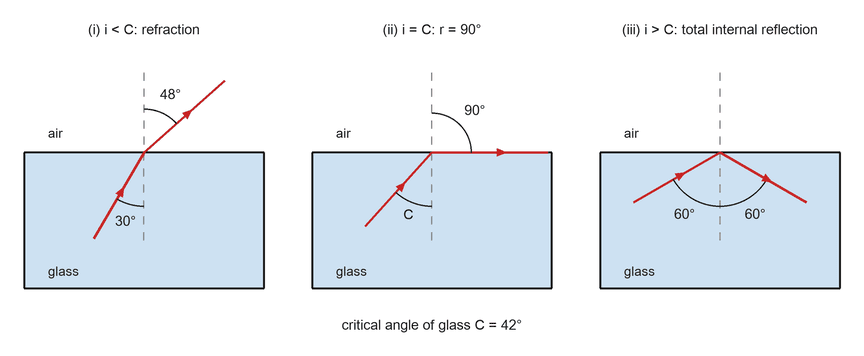
Step 2 — Part (i): see it in a figure.
In panel (ii) of the figure the ray inside glass meets the surface at the critical angle C and the refracted ray grazes along the surface. A smaller angle lets the ray out; a larger one gives total internal reflection.
Step 3 — Part (ii): one factor that affects it.
The colour (wavelength) of light. Since sin C = 1/μ and the refractive index is less for red light than for violet light, the critical angle is larger for red light than for violet light.
Step 4 — Part (ii): another factor.
The temperature of the medium also matters: a rise in temperature lowers the refractive index, so the critical angle increases.
Watch out: The critical angle is an angle of INCIDENCE in the denser medium, not an angle of refraction.
Therefore, (i) the critical angle is the angle of incidence in the denser medium for which the angle of refraction in the rarer medium is 90°; (ii) the colour (wavelength) of the light used (the temperature of the medium also affects it).