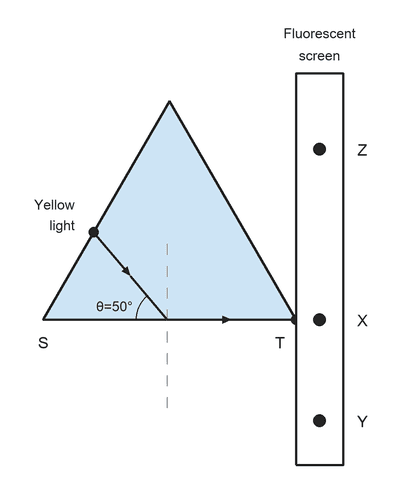
Solution:
Concept: Critical angle (C): the angle of incidence in the denser medium for which the angle of refraction in the rarer medium is 90°. For glass or water to air, sinC=μ1. Refractive index and colour: in glass or water, light of shorter wavelength travels more slowly, so the refractive index is larger for violet and blue light and smallest for red light (order: red < orange < yellow < green < blue < indigo < violet).
Given: Yellow ray inside the prism makes θ = 50° with ST and emerges along ST to X.
Step 1 — Part (a): find the angle of incidence at ST.
The yellow ray reaches X by travelling along ST, so at the base it is refracted at 90°. The ray inside makes θ = 50° with the surface ST; the angle of incidence is measured from the normal:
i=90∘−50∘=40∘
Step 2 — Part (a): recognise the critical angle.
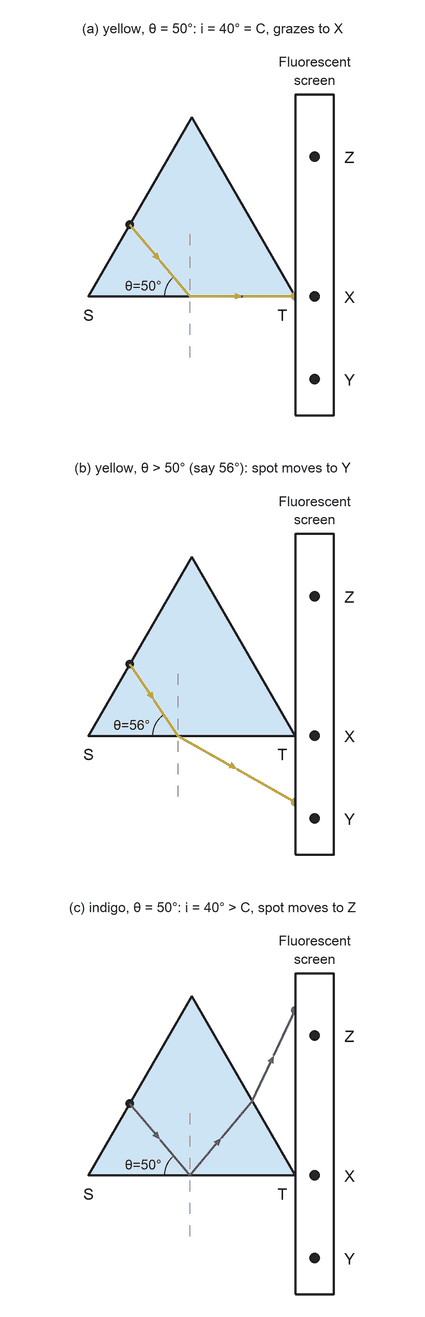
An angle of refraction of 90° means this angle of incidence is the critical angle: C = 40° for yellow light (a refractive index of 1/sin 40° ≈ 1.56).
Step 3 — Part (b): move the spot towards Y.
To reach Y (below X), the ray must come out through ST and go downwards, so its angle of incidence must be less than 40°. Since i = 90° − θ, a smaller i needs a larger θ: θ > 50°.
Step 4 — Part (c): indigo light.
The prism's refractive index is greater for indigo than for yellow, so its critical angle for indigo is less than 40°. The ray still meets ST at 40°, now greater than the critical angle, so it is totally reflected upwards, leaves through the other face and strikes the screen above X. The spot moves towards Z.
Watch out: Θ is measured from the SURFACE; the angle of incidence is 90° − θ.
Therefore, (a) the critical angle for yellow light is 40°; (b) θ should be > 50; (c) the spot moves towards Z.