Solution:
Concept: Refraction: light bends when it passes obliquely from one medium into another because its speed changes. Going into an optically denser medium it bends towards the normal; going into a rarer medium it bends away from the normal. Snell's law: sinrsini is a constant (the refractive index) for a given pair of media and a given colour of light. All angles are measured from the normal, not from the surface. Principle of reversibility: a ray of light that is reversed retraces its path. So the refractive index of medium 1 with respect to medium 2 is the reciprocal of that of medium 2 with respect to medium 1: 1μ2×2μ1=1.
Step 1 — Part (a): the ratio at the first surface.
Going from air into glass, Snell's law gives
sinr1sini1=aμg
Step 2 — Part (a): the ratio at the second surface.
Going from glass back into air, the ratio is the reciprocal:
sinr2sini2=aμg1
Step 3 — Part (a): multiply.
The product of the two ratios is
product=aμg×aμg1=1
This holds whether or not the surfaces are parallel.
Step 4 — Part (b): decide.
The opposite surfaces are not parallel.
Step 5 — Part (c): give the reason.
If the surfaces were parallel, their normals would be parallel too. The ray inside would then cut the two parallel normals at equal alternate angles, so the angle of refraction at the first surface would equal the angle of incidence at the second. Here these angles are not equal, so the normals, and therefore the surfaces, are not parallel.
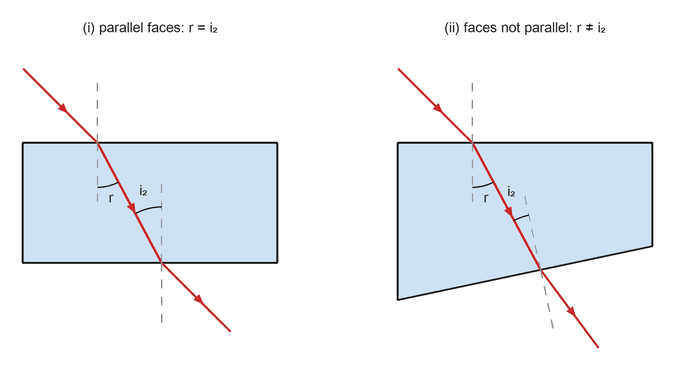
Watch out: The product of the two ratios is 1 for ANY block; it is the equality r₁ = i₂ that needs parallel faces.
Therefore, (a) the product is 1; (b) the surfaces are not parallel; (c) for parallel surfaces the normals are parallel, so r at the first surface would equal i at the second (alternate angles); they are unequal here.
