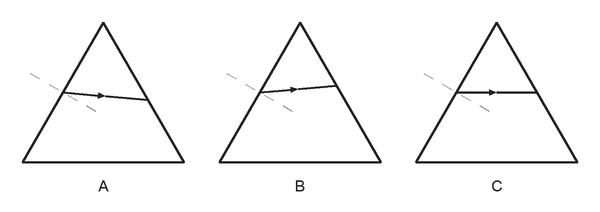
Solution:
Concept: Refraction: light bends when it passes obliquely from one medium into another because its speed changes. Going into an optically denser medium it bends towards the normal; going into a rarer medium it bends away from the normal. Snell's law: sinrsini is a constant (the refractive index) for a given pair of media and a given colour of light. All angles are measured from the normal, not from the surface. Minimum deviation: as the angle of incidence increases, the deviation first decreases, reaches a least value δmin, then increases. At minimum deviation the ray passes symmetrically: the ray inside is parallel to the base, r1 and r2 are equal (each is 2A), and the angle of emergence equals the angle of incidence.
Given: Identical prisms A, B, C; the same monochromatic ray at different angles of incidence.
Step 1 — Relate the angle of incidence to the ray inside.
At the first face sin i = μ sin r, so the larger the angle of incidence, the larger the angle of refraction: the refracted ray turns farther from the normal, that is, more upwards towards the apex.
Step 2 — Read the three diagrams.
The ray enters at the same point with the same normal in all three. In A the refracted ray slopes down (closest to the normal, smallest r). In C it is parallel to the base. In B it slopes up (farthest from the normal, largest r).
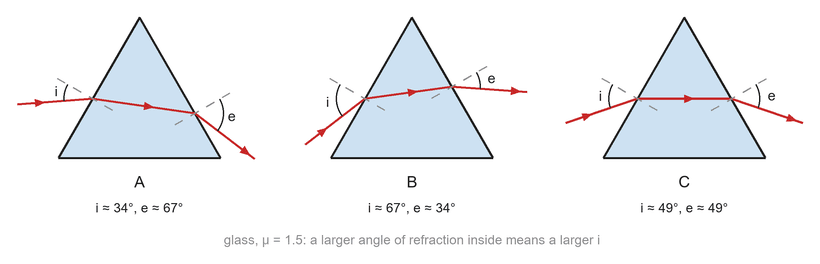
Step 3 — Parts (a) and (b).
The largest angle of refraction goes with the largest angle of incidence: B. The smallest goes with the smallest: A.
Step 4 — Part (c).
When the ray inside is parallel to the base, it passes symmetrically through the prism, so i = e (minimum deviation): C.
Watch out: A refracted ray sloping UP inside the prism has the LARGER angle of refraction (it is farther from the inward normal, which points down).
Therefore, (a) prism B; (b) prism A; (c) prism C.