
Question 253 marksAsked 2023Medium
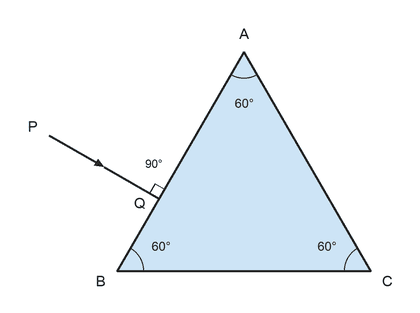
Copy the diagram given below and complete the path of the light ray PQ, as it emerges out of the prism by marking necessary angles. The critical angle of glass is 42°.
Confirming your payment
Sign up now and get 250 free tokens.
Previous Year Questions · Question 25 of 57
Copy the diagram given below and complete the path of the light ray PQ, as it emerges out of the prism by marking necessary angles. The critical angle of glass is 42°.
Solution:
Concept: A ray that meets a surface along the normal (angle of incidence 0°) passes into the next medium without bending (angle of refraction 0°). Total internal reflection: it happens only when light goes from a denser to a rarer medium and the angle of incidence is greater than the critical angle. Then no light is refracted out; all of it is reflected back, obeying the laws of reflection (angle of reflection = angle of incidence).
Given: Equilateral prism ABC, ray PQ normal to AB, critical angle of glass 42°.
Step 1 — At Q on face AB.
The ray PQ meets AB at 90° to the face, that is along the normal, so the angle of incidence is 0° and it goes straight in, perpendicular to AB.
Step 2 — Find the angle of incidence at the base BC.
The ray is perpendicular to AB and the normal at R is perpendicular to BC, so the angle of incidence at R equals ∠B:
Step 3 — Decide what happens at R.
Since 60° is greater than the critical angle (42°), the ray suffers total internal reflection at R, with an angle of reflection of 60°.
Step 4 — At S on face AC.
The reflected ray makes 30° with BC, and ∠C is 60°. In the triangle formed with AC, the angle at which the ray meets AC is
So the ray meets AC along the normal (angle of incidence 0°) and passes out undeviated.

Watch out: Angles of incidence and refraction are measured from the normal; if a figure gives the angle with the surface, subtract it from 90°.
Therefore, the ray enters AB undeviated (i = 0°), is totally internally reflected at BC (i = 60°, reflected at 60°) and emerges normally through AC (i = 0°).