
Question 243 marksAsked 2023Medium
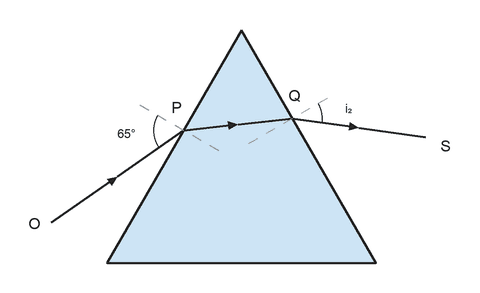
The diagram below shows the ray OP travelling through an equilateral prism of a certain material.
(a) Calculate the value of , if the angle of deviation is 43°.
(b) What is the ray QS called?
Confirming your payment
Sign up now and get 250 free tokens.
Previous Year Questions · Question 24 of 57
The diagram below shows the ray OP travelling through an equilateral prism of a certain material.
(a) Calculate the value of , if the angle of deviation is 43°.
(b) What is the ray QS called?
Solution:
Concept: Prism: for a prism of angle A, the angle of deviation is , where is the angle of incidence and the angle of emergence. Inside, the angles of refraction at the two faces satisfy .
Given: Equilateral prism (A = 60°), angle of incidence = 65°, angle of deviation δ = 43°.
Step 1 — Part (a): write the deviation formula.
For a prism, the deviation equals the angle of incidence plus the angle of emergence minus the angle of the prism:
Step 2 — Part (a): rearrange for the angle of emergence.
Adding A and subtracting on both sides:
Step 3 — Part (a): put in the values.
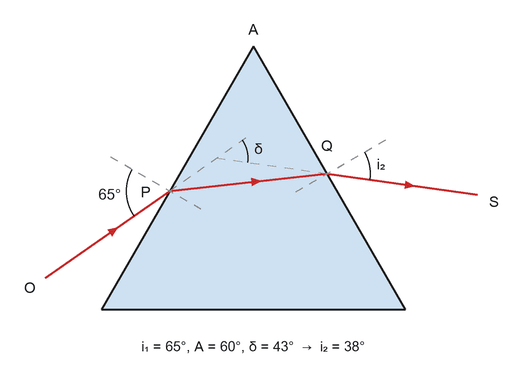
The prism is equilateral, so A = 60°; the figure gives = 65° and the stem gives δ = 43°:
Step 4 — Check that the numbers fit a real prism.
With = 65° and = 38°, Snell's law at both faces with gives a refractive index of about 1.53, an ordinary glass value. The figure below is drawn with it.
Step 5 — Part (b): name the ray QS.
QS is the ray that leaves the prism, so it is the emergent ray.
Watch out: Subtract the prism angle A (not add it) when you use δ = i₁ + i₂ − A.
Therefore, (a) = 38°; (b) QS is the emergent ray.