
Question 281 markMCQAsked 2024Medium
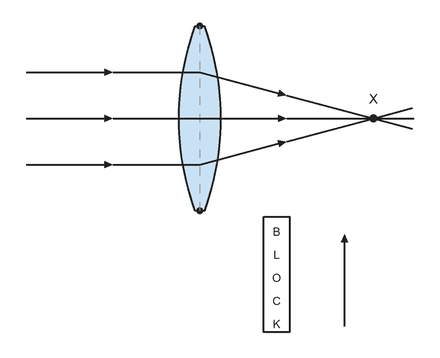
A block of glass is pushed into the path of the light as shown below. Then the converging point X will :
Confirming your payment
Sign up now and get 250 free tokens.
Previous Year Questions · Question 28 of 57
A block of glass is pushed into the path of the light as shown below. Then the converging point X will :
(A) Move away from the slab
(B) Move towards the slab
(C) Not shift
(D) Move towards the left side of the lens
Answer: (A) Move away from the slab
Concept: A parallel-sided glass block does not change the direction of a ray; it only shifts it sideways (lateral displacement). For a converging beam this carries the meeting point farther along the beam.
Step 1 — What a parallel-sided block does to a ray.
Each converging ray bends towards the normal on entering the block and away from the normal on leaving it by the same amount, so it comes out parallel to its old path, shifted sideways.
Step 2 — Which way the rays are shifted.
Inside the block each ray is less steep, so it gets less close to the axis than it would have done. When it leaves, it is farther from the axis than before and still slopes the same way, so it reaches the axis later, at X′ beyond X.

Step 3 — How far the point moves.
For nearly axial rays the meeting point moves forward by about t(1 − 1/μ), where t is the thickness of the block; for a 1.2 cm block of μ = 1.5 that is about 0.4 cm. This is the same rule as the apparent rise of a coin seen through water.
Watch out: The block does not converge the light more; it leaves each ray parallel to its old path.
Why the other options are wrong:
Therefore, the converging point X moves away from the slab, option (A).