Solution:
Concept: (a) The colour that is scattered least travels farthest through air. Critical angle (C): the angle of incidence in the denser medium for which the angle of refraction in the rarer medium is 90°. For glass or water to air, sinC=μ1. Refractive index and colour: in glass or water, light of shorter wavelength travels more slowly, so the refractive index is larger for violet and blue light and smallest for red light (order: red < orange < yellow < green < blue < indigo < violet).
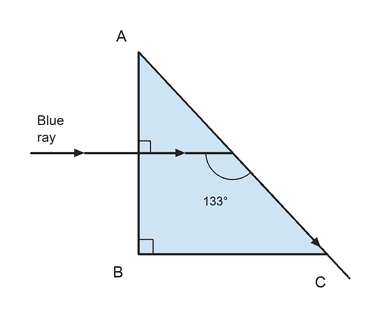
Given: A blue ray enters AB normally and emerges grazing along AC; the angle between the ray and AC is 133°.
Step 1 — Part (a): why red is used.
Red light has the longest wavelength in the visible spectrum, so it is scattered the least by air molecules, dust and fog. It travels farthest without fading and is seen from a long distance, so it is used as a danger signal.
Step 2 — Part (b) 1: find the angle of incidence at AC.
The figure shows 133° between the ray inside and the face AC (measured on the side of C). The normal to AC makes 90° with the face, so the angle between the ray and the normal is
i=133∘−90∘=43∘
Step 3 — Part (b) 1: recognise the critical angle.
The blue ray emerges grazing along AC (angle of refraction 90°), so this angle of incidence is the critical angle for blue light: C = 43°.

Step 4 — Part (b) 2: find the angle of the prism.
The ray inside is perpendicular to AB (it entered normally), and the normal at AC is perpendicular to AC. So the angle between the ray and the normal equals the angle between AB and AC, which is ∠A:
A=43∘
Step 5 — Part (b) 3: choose the colour for total internal reflection.
The angle of incidence stays 43°, so it must become greater than the critical angle. That needs a colour with a smaller critical angle, that is a larger refractive index than blue: violet (indigo would also do).
Watch out: 133° is the angle with the FACE; the angle of incidence is measured from the normal, so subtract 90°.
Therefore, (a) red light is scattered least, so it is seen from the farthest distance; (b) 1. the critical angle for blue light is 43°; 2. the angle of the prism A = 43°; 3. violet light (a colour with a larger refractive index than blue).