Solution:
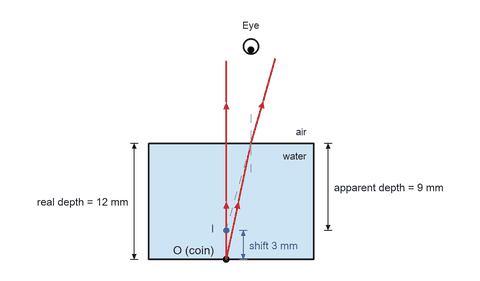
Concept: Real and apparent depth: an object inside a denser medium, seen from above (nearly along the normal), appears raised, because rays from it bend away from the normal on coming out. μ=apparent depthreal depth, and the shift (apparent rise) is real depth − apparent depth. Critical angle (C): the angle of incidence in the denser medium for which the angle of refraction in the rarer medium is 90°. For glass or water to air, sinC=μ1.
Given: Μ of water = 4/3; the coin appears raised by 3.0 mm.
Step 1 — Part (a): write the shift in terms of the real depth.
The apparent depth is the real depth divided by μ, so the shift (apparent rise) is
shift=real depth×(1−μ1)
Step 2 — Part (a): work out the bracket.
For water, μ = 4/3, so 1/μ = 3/4:
1−μ1=1−43=41
Step 3 — Part (a): find the real depth.
The shift is 3.0 mm and it is one quarter of the real depth:
real depth=1/43.0 mm=12 mm
Step 4 — Part (a): check.
The apparent depth is 12 ÷ (4/3) = 9 mm, and 12 − 9 = 3 mm, which is the given shift.
Step 5 — Part (b): the critical angle.
At the critical angle the refracted ray in air makes 90° with the normal, and Snell's law then gives
sinC=μ1
Watch out: The 3.0 mm is the SHIFT, not the apparent depth; the shift is only a quarter of the real depth for water.
Therefore, (a) the coin is 12 mm (1.2 cm) deep in the water; (b) sin C = 1/μ, so a larger refractive index means a smaller critical angle.
