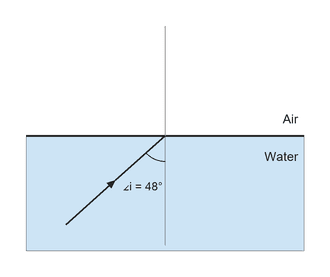
Solution:
Concept: Critical angle (C): the angle of incidence in the denser medium for which the angle of refraction in the rarer medium is 90°. For glass or water to air, sinC=μ1. Total internal reflection: it happens only when light goes from a denser to a rarer medium and the angle of incidence is greater than the critical angle. Then no light is refracted out; all of it is reflected back, obeying the laws of reflection (angle of reflection = angle of incidence).
Given: A ray in water meets the surface at 48°; critical angle of water 48°.
Step 1 — Part (i): compare the angle with the critical angle.
The ray in water meets the surface at an angle of incidence of 48°, which is exactly the critical angle for water.
Step 2 — Part (i): complete the path.
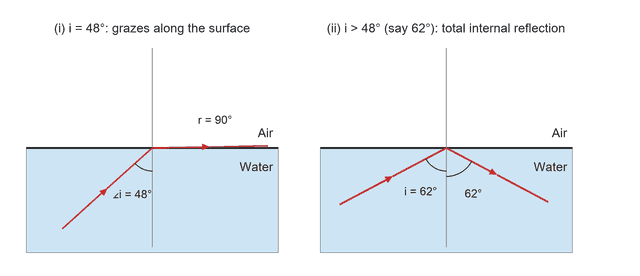
At the critical angle the angle of refraction is 90°. So the refracted ray grazes along the water–air surface.
Step 3 — Part (ii): the condition for total internal reflection.
The light is already going from a denser medium (water) to a rarer medium (air). So the only further condition is that the angle of incidence in water must be greater than 48°. The ray then does not come out into air at all; it is totally reflected back into the water.
Watch out: At exactly the critical angle the ray grazes the surface; total internal reflection needs an angle greater than the critical angle.
Therefore, (i) the ray is refracted at 90° and grazes along the water surface; (ii) the angle of incidence in water must be greater than the critical angle, 48°.