Solution:
Concept: Critical angle (C): the angle of incidence in the denser medium for which the angle of refraction in the rarer medium is 90°. For glass or water to air, sinC=μ1. Total internal reflection: it happens only when light goes from a denser to a rarer medium and the angle of incidence is greater than the critical angle. Then no light is refracted out; all of it is reflected back, obeying the laws of reflection (angle of reflection = angle of incidence).
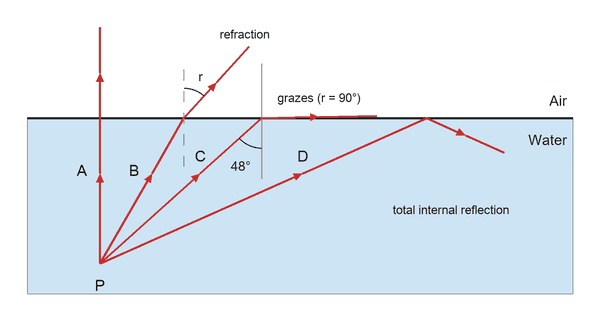
Given: Point source P in water; rays A, B, C, D; critical angle of water 48°.
Step 1 — Ray A.
Ray A meets the surface along the normal (i = 0°), so it passes into air without bending.
Step 2 — Ray B.
Ray B meets the surface at an angle of incidence less than 48°. It is refracted into air, bending away from the normal (its angle of refraction is greater than its angle of incidence). A weak reflected ray also returns into the water.
Step 3 — Ray C.
Ray C meets the surface at 48°, the critical angle. It is refracted at 90° and grazes along the water surface.
Step 4 — Ray D.
Ray D meets the surface at an angle greater than 48°. It cannot come out, so it suffers total internal reflection and returns into the water, with its angle of reflection equal to its angle of incidence.
Step 5 — Part (ii): name the phenomena.
Ray B shows refraction (from water into air). Ray D shows total internal reflection.
Watch out: Compare each ray's angle with the NORMAL at the surface (not with the surface) against 48°.
Therefore, (i) A goes straight out undeviated, B refracts out bending away from the normal, C grazes along the surface and D is totally reflected back into the water; (ii) B shows refraction and D shows total internal reflection.

