
Question 422 marksAsked 2025Medium
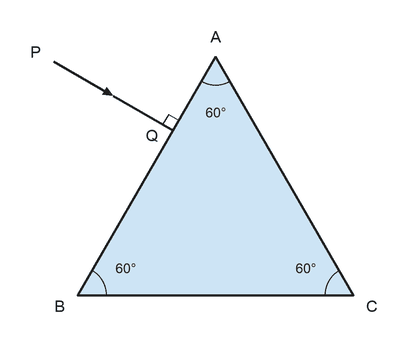
A ray of light PQ is incident normally on the face AB of an equilateral prism. The ray gets totally reflected from the surface AC.
Calculate:
(a) the angle of deviation at AC.
(b) the angle of incidence at BC.
Confirming your payment
Sign up now and get 250 free tokens.
Previous Year Questions · Question 42 of 57
A ray of light PQ is incident normally on the face AB of an equilateral prism. The ray gets totally reflected from the surface AC.
Calculate:
(a) the angle of deviation at AC.
(b) the angle of incidence at BC.
Solution:
Concept: A ray that meets a surface along the normal (angle of incidence 0°) passes into the next medium without bending (angle of refraction 0°). Total internal reflection: it happens only when light goes from a denser to a rarer medium and the angle of incidence is greater than the critical angle. Then no light is refracted out; all of it is reflected back, obeying the laws of reflection (angle of reflection = angle of incidence).
Given: Equilateral prism ABC; PQ normal to AB; the ray is totally reflected at AC.
Step 1 — Part (a): angle of incidence at AC.
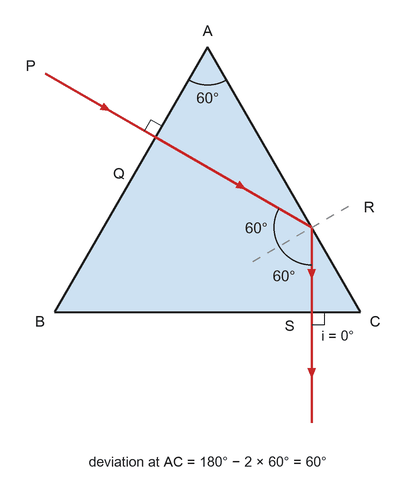
PQ enters AB normally, so it is not bent. The ray inside is perpendicular to AB, and the normal at AC is perpendicular to AC, so the angle of incidence at AC equals the angle between AB and AC, the prism angle:
Step 2 — Part (a): deviation at AC.
On total reflection the ray turns through 180° − 2i:
Step 3 — Part (b): angle of incidence at BC.
The ray was travelling at 30° below the horizontal; turning it through 60° makes it travel straight down, perpendicular to BC. So it meets BC along the normal: the angle of incidence at BC is 0°, and it leaves BC undeviated.
Watch out: The deviation on reflection is 180° − 2i (= 60°), not the angle of incidence itself (also 60° here, by coincidence).
Therefore, (a) the angle of deviation at AC is 60°; (b) the angle of incidence at BC is 0°.