Solution:
Concept: Real and apparent depth: an object inside a denser medium, seen from above (nearly along the normal), appears raised, because rays from it bend away from the normal on coming out. μ=apparent depthreal depth, and the shift (apparent rise) is real depth − apparent depth.
Given: Water 8 cm deep; μ = 4/3; glass wall negligible.
Step 1 — Part (a): write the shift.
The thin glass wall can be ignored, so only the 8 cm of water matters. The apparent depth is real depth ÷ μ, so the shift is
shift=real depth×(1−μ1)
Step 2 — Part (a): put in the values.
With μ = 4/3, the bracket is 1 − 3/4 = 1/4:
shift=8×41=2 cm
The coin appears 8 − 2 = 6 cm deep instead of 8 cm.
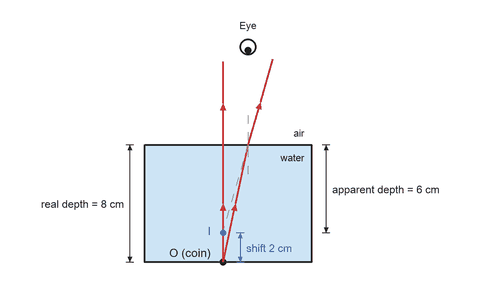
Step 3 — Part (b): effect of warming the water.
Warming lowers the refractive index of water. Since apparent depth = real depth ÷ μ, a smaller μ gives a larger apparent depth: the coin appears less raised.
Watch out: The shift is real depth × (1 − 1/μ), not real depth ÷ μ (that is the apparent depth).
Therefore, (a) the coin appears raised by 2 cm (it looks 6 cm deep); (b) the apparent depth increases.
