
Question 221 markMCQAsked 2023Easy
When a ray of light travels normal to the given surface, then the angle of refraction is:
Confirming your payment
Sign up now and get 250 free tokens.
Previous Year Questions · Question 22 of 57
When a ray of light travels normal to the given surface, then the angle of refraction is:
(A) 180°
(B) 90°
(C) 0°
(D) 45°
Answer: (C) 0°
Concept: A ray that meets a surface along the normal (angle of incidence 0°) passes into the next medium without bending (angle of refraction 0°).
Step 1 — Write the angle of incidence.
A ray travelling along the normal makes an angle of incidence of 0°.
Step 2 — Apply Snell's law.
Snell's law gives the sine of the angle of refraction as sin i ÷ μ. We put in i = 0°:
So the angle of refraction is 0°: the ray passes into the second medium without bending.
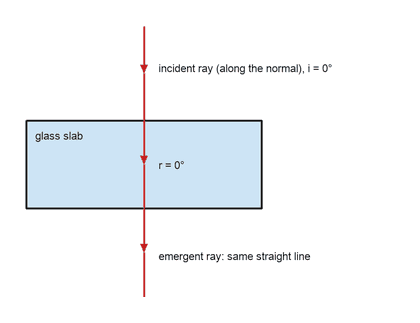
Watch out: An angle of 90° to the SURFACE is an angle of 0° to the NORMAL; the question asks for the angle from the normal.
Why the other options are wrong:
Therefore, the angle of refraction is 0°, option (C).