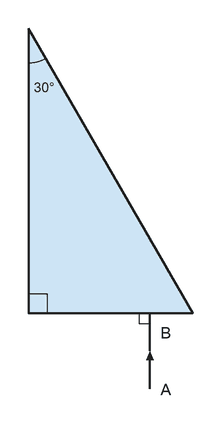
Solution:
Concept: (a) Some substances fluoresce (glow) under ultraviolet light. (b) A ray that meets a surface along the normal (angle of incidence 0°) passes into the next medium without bending (angle of refraction 0°). Total internal reflection: it happens only when light goes from a denser to a rarer medium and the angle of incidence is greater than the critical angle. Then no light is refracted out; all of it is reflected back, obeying the laws of reflection (angle of reflection = angle of incidence).
Given: 30°–60°–90° prism with 30° at the top; AB enters the base normally; critical angle 42°.
Step 1 — Part (a): fake currency.
The radiation used is ultraviolet (U.V.) radiation. Security marks printed on genuine notes glow (fluoresce) under ultraviolet light; a fake note lacks them.
Step 2 — Part (b): at B on the base.
AB falls normally on the base, so i = 0° and the ray goes straight up into the prism.
Step 3 — Part (b): angle of incidence at the slant face.
The angle between the base and the slant face is 90° − 30° = 60°, and the ray is perpendicular to the base, so it meets the slant face at an angle of incidence of 60°. Since 60° > 42°, it is totally internally reflected.
Step 4 — Part (b): at the vertical face.
The reflected ray travels up to the left and meets the vertical face at an angle of incidence of 30°. Since 30° < 42°, it refracts out into air, bending away from the normal:
e=48∘

Watch out: Angles of incidence and refraction are measured from the normal; if a figure gives the angle with the surface, subtract it from 90°.
Therefore, (a) ultraviolet radiation; (b) the ray is totally reflected at the slant face (i = 60°) and emerges through the vertical face (i = 30°), bending away from the normal at about 48°.