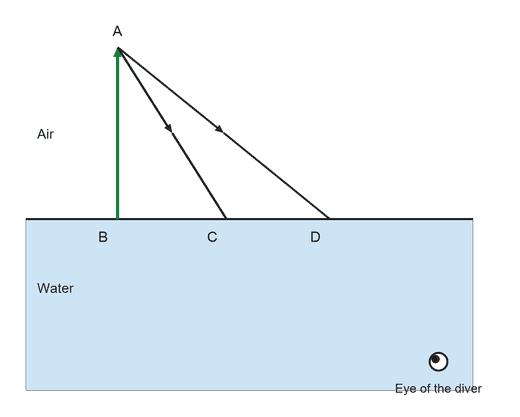
Solution:
Concept: Refraction: light bends when it passes obliquely from one medium into another because its speed changes. Going into an optically denser medium it bends towards the normal; going into a rarer medium it bends away from the normal. Snell's law: sinrsini is a constant (the refractive index) for a given pair of media and a given colour of light. All angles are measured from the normal, not from the surface.
Given: A diver in water looks obliquely at an object AB standing in air.
Step 1 — Part (i): direction of the light.
Light from the object travels from air (rarer) into water (denser), so at the surface it bends towards the normal.
Step 2 — Part (ii): ray AC.
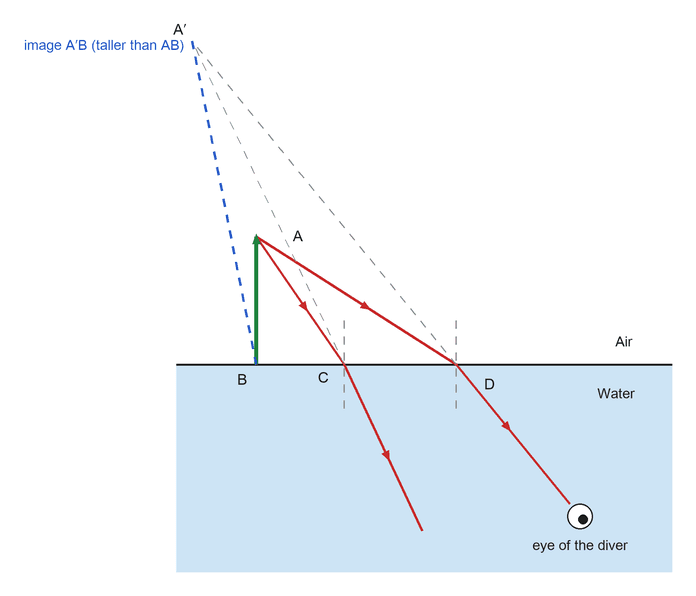
At C the ray AC enters the water and bends towards the normal, then goes on down into the water.
Step 3 — Part (ii): ray AD.
At D the ray AD also bends towards the normal. It meets the surface more obliquely than AC, so it is bent more.
Step 4 — Part (ii): locate the image.
The diver's eye receives the refracted rays. Produce them backwards (dashed lines): they meet at A′, which lies higher than A. The foot B is on the surface, so its image is B itself. A′B is the image: virtual, and taller than AB. (The figure is traced with μ = 4/3 for the two rays shown.)
Step 5 — Part (i): conclude.
Since the image A′B reaches higher than the object, the object appears taller to the diver.
Watch out: Light here goes from AIR into WATER, so it bends towards the normal; the image of an object in air seen from water is raised, not lowered.
Therefore, (i) the object appears taller to the diver; (ii) the rays AC and AD bend towards the normal in water, and traced back they meet at A′ above A, so A′B is the (virtual) image.