
Question 531 markMCQAsked 2026Easy
A crack in a glass vessel often shines, like a mirror, in sunlight. Which of the following phenomenon of light is responsible for this?
Confirming your payment
Sign up now and get 250 free tokens.
Previous Year Questions · Question 53 of 57
A crack in a glass vessel often shines, like a mirror, in sunlight. Which of the following phenomenon of light is responsible for this?
(A) reflection
(B) refraction
(C) dispersion
(D) total internal reflection
Answer: (D) total internal reflection
Concept: Total internal reflection: it happens only when light goes from a denser to a rarer medium and the angle of incidence is greater than the critical angle. Then no light is refracted out; all of it is reflected back, obeying the laws of reflection (angle of reflection = angle of incidence).
Step 1 — Identify the two media.
A crack in glass is a thin layer of air (rarer) inside glass (denser).
Step 2 — Compare with the critical angle.
Sunlight inside the glass meets the surface of the crack, going from glass to air. Where it strikes at an angle greater than the critical angle of glass (about 42°), all of it is totally reflected.
Step 3 — Explain the shine.
This bright reflected light reaches the eye, so the crack shines like a mirror.
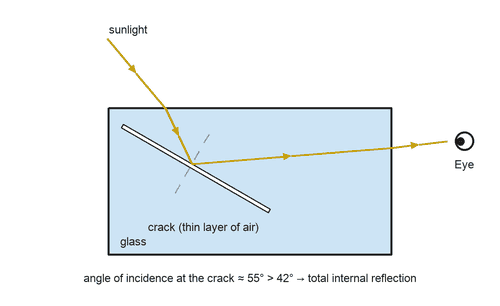
Watch out: Ordinary reflection at a glass–air surface returns only a few per cent of the light; the mirror-like shine needs TOTAL reflection.
Why the other options are wrong:
Therefore, the crack shines because of total internal reflection, option (D).