
Question 374 marksEasy
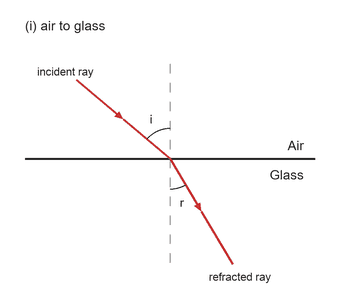
Draw diagrams to show the refraction of light from (i) air to glass, and (ii) glass to air. In each diagram, label the incident ray, refracted ray, the angle of incidence () and the angle of refraction ()
Confirming your payment
Sign up now and get 250 free tokens.
Refraction of Light at Plane Surfaces · Question 37 of 139
Draw diagrams to show the refraction of light from (i) air to glass, and (ii) glass to air. In each diagram, label the incident ray, refracted ray, the angle of incidence () and the angle of refraction ()
Solution:
Concept: Refraction is the change in direction of light when it passes obliquely from one transparent medium into another. It happens because light travels at different speeds in different media. Light bends towards the normal when it enters an optically denser medium (it slows down) and away from the normal when it enters an optically rarer medium (it speeds up). All angles are measured from the normal, the line at 90° to the surface at the point of incidence.
Step 1 — Draw the normal first.
In each diagram draw the surface, then the normal (dotted) at the point of incidence, and measure both angles from it.
(i) Air to glass
Step 2 — Bend towards the normal.
Glass is optically denser, so the refracted ray bends towards the normal: r < i.
(ii) Glass to air
Step 3 — Bend away from the normal.
Air is optically rarer, so the refracted ray bends away from the normal: r > i.

Step 4 — Label each diagram.
Show the surface, the normal, the incident ray and the refracted ray with arrows, and the angles i and r, each measured from the normal.
Watch out: Angles of incidence and refraction are measured from the normal, never from the surface.
Therefore, from air to glass the ray bends towards the normal (r < i), and from glass to air it bends away from the normal (r > i).