
Question 383 marksEasy
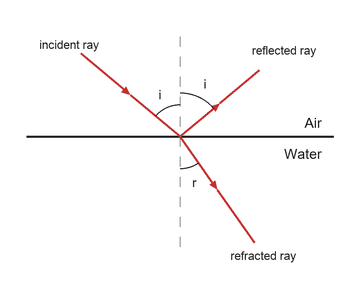
A light ray suffers reflection and refraction at the boundary in passing from air to water. Draw a neat labelled ray diagram to show it.
Confirming your payment
Sign up now and get 250 free tokens.
Refraction of Light at Plane Surfaces · Question 38 of 139
A light ray suffers reflection and refraction at the boundary in passing from air to water. Draw a neat labelled ray diagram to show it.
Solution:
Concept: At the air–water boundary light is partly reflected and partly refracted. The reflected ray obeys the laws of reflection (angle of reflection = angle of incidence); the refracted ray obeys Snell's law.
Step 1 — Draw the reflected ray.
A small part of the light goes back into the air on the other side of the normal, at an angle equal to the angle of incidence i.
Step 2 — Draw the refracted ray.
Most of the light enters the water. Water is optically denser than air, so the ray bends towards the normal: r < i, with sin i ÷ sin r equal to 4/3.
Step 3 — Label the diagram.
Show the air–water surface, the normal at the point of incidence, the incident, reflected and refracted rays with arrows, the two equal angles i and the angle r.
Therefore, the diagram shows one incident ray giving a weaker reflected ray at angle i and a refracted ray bent towards the normal (r < i).