
Question 362 marksEasy
When an illuminated object is held in front of a thick plane glass mirror, several images are seen, out of which the second image is brightest. Give reason.
Confirming your payment
Sign up now and get 250 free tokens.
Refraction of Light at Plane Surfaces · Question 36 of 139
When an illuminated object is held in front of a thick plane glass mirror, several images are seen, out of which the second image is brightest. Give reason.
Solution:
Concept: A thick glass mirror reflects light at two surfaces: weakly at the front (unsilvered) glass surface and strongly at the silvered back surface. Each reflection forms an image.
Step 1 — The first image is faint.
At the front surface only a small part of the light (about 4% for glass) is reflected. This forms the first, faint image.
Step 2 — The second image is the brightest.
Most of the light (about 96%) is refracted into the glass, reaches the silvered back surface and is strongly reflected there. It comes out through the front surface and forms the second image, which carries most of the light.
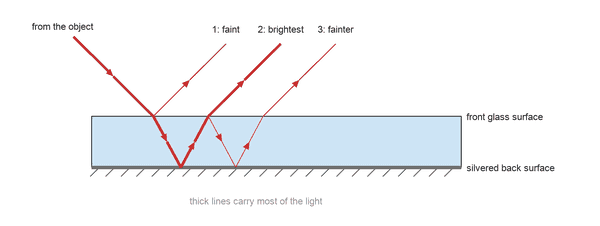
Step 3 — Further images are fainter.
At the front surface a little of this light is reflected back inside again, reflected by the silvering, and comes out to form more images, each fainter than the one before.
Therefore, the second image is brightest because it is formed by the strong reflection at the silvered back surface, which receives most of the light.