Solution:
Concept: A clear, colourless glass piece in a liquid is seen only because light bends (and partly reflects) at its surface. If light crosses its surface with no change of speed, nothing marks the boundary and the glass cannot be told apart from the liquid. The refractive index of a medium depends on the colour (wavelength) of light: it is greatest for violet (shortest wavelength) and least for red (longest wavelength). So violet light travels slowest in glass and bends the most.
(i) When the glass piece is not seen
Step 1 — Match the refractive indices.
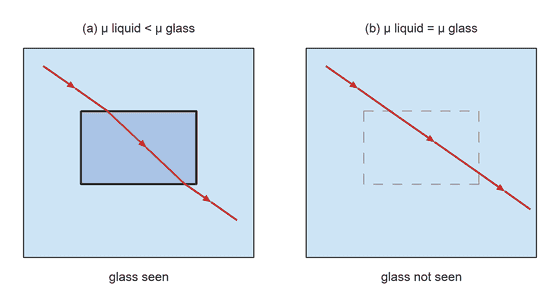
The refractive index of the liquid changes with temperature. At one particular temperature it becomes equal to the refractive index of the glass.
Step 2 — See what happens to the light.
Light then passes from the liquid into the glass and out again with no change of speed, so there is no refraction and no reflection at the glass surface. The glass piece cannot be seen.
(ii) Why light of a single colour is used
Step 3 — Use the colour dependence.
The refractive index of each medium is different for different colours. With white light, the two indices could be equal for only one colour at a time, and the glass would still be seen in the other colours. With light of one colour they can be matched exactly.
Therefore, (i) the glass piece is not seen when the refractive index of the liquid equals that of the glass, and (ii) single-colour light is used because the refractive index depends on colour.
