Answer: (D) (d)
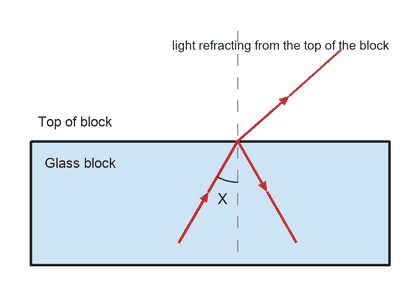
Concept: Total internal reflection happens when light goes from a denser to a rarer medium and meets the surface at an angle of incidence greater than the critical angle. Then no light is refracted out: all of it is reflected back into the denser medium, obeying the laws of reflection. X is the angle of incidence inside the glass at the top face.
Step 1 — Read the figure.
In the figure X is less than 42°, the critical angle of glass, so light refracts out of the top face.
Step 2 — Change X.
As X is increased, the refracted ray bends further from the normal. Once X is more than 42°, no light refracts out; all of it is reflected back into the block.

Watch out: There is no such thing as "total internal refraction"; the effect is a reflection.
Why the other options are wrong:
- (A) (a): decreasing X lets even more light pass out of the top.
- (B) (b): decreasing X lets more light out, and "total internal refraction" is not a real effect.
- (C) (c): X must be increased, but "total internal refraction" is not a real effect; it is total internal reflection.
Therefore, X is increased and the effect is total internal reflection, option (D).