
Question 682 marksEasy
How does the angle of deviation depend on the refracting angle of the prism ?
Confirming your payment
Sign up now and get 250 free tokens.
Refraction of Light at Plane Surfaces · Question 68 of 139
How does the angle of deviation depend on the refracting angle of the prism ?
Solution:
Concept: A prism refracts a ray twice, at two faces inclined at the angle of the prism A. Inside, the angles of refraction at the two faces add up to A (r₁ + r₂ = A); the total turning of the ray is the angle of deviation (δ = i₁ + i₂ − A), where i₁ is the angle of incidence and i₂ the angle of emergence. Both bends turn the ray towards the base of the prism.
Step 1 — See what a larger A does inside.
With a larger angle between the faces, r₂ (equal to A − r₁) is larger, so the ray meets the second face at a larger angle and bends more there.
Step 2 — Give an example.
A glass prism (μ = 1.5) of angle 40° gives a minimum deviation of about 21.7°, while one of angle 60° gives about 37.2°.
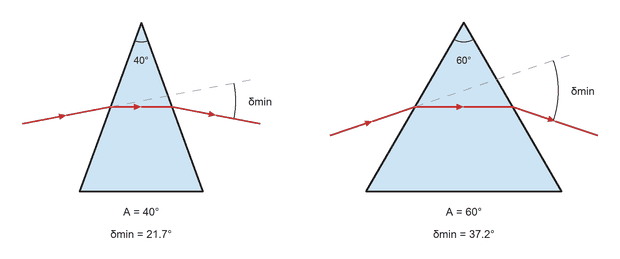
Therefore, the angle of deviation increases as the refracting angle of the prism increases.