
Question 652 marksEasy
How does the deviation produced by a prism depend on (i) the refractive index of its material, and (ii) the wavelength of incident light.
Confirming your payment
Sign up now and get 250 free tokens.
Refraction of Light at Plane Surfaces · Question 65 of 139
How does the deviation produced by a prism depend on (i) the refractive index of its material, and (ii) the wavelength of incident light.
Solution:
Concept: Deviation comes from the bending at the two faces. Anything that makes the glass bend light more increases the deviation. The refractive index of a medium depends on the colour (wavelength) of light: it is greatest for violet (shortest wavelength) and least for red (longest wavelength). So violet light travels slowest in glass and bends the most.
(i) Refractive index of the material
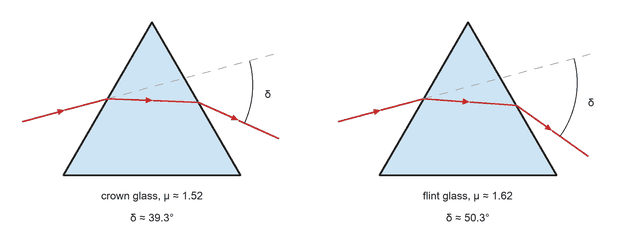
Step 1 — Effect of μ.
The higher the refractive index, the greater the deviation. A flint-glass prism (higher μ) deviates light more than a crown-glass prism of the same angle.
(ii) Wavelength of incident light
Step 2 — Effect of wavelength.
The longer the wavelength, the smaller the deviation, because μ decreases as the wavelength increases. Red light (longest wavelength) is deviated least and violet (shortest) most.
Therefore, the deviation (i) increases with the refractive index, and (ii) decreases as the wavelength increases.