Solution:
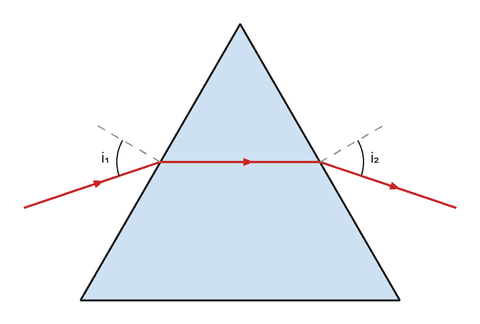
Concept: As the angle of incidence increases, the deviation produced by a prism first decreases, reaches a minimum δmin, and then increases. At minimum deviation the ray passes symmetrically: the angles of incidence and emergence are equal (each i), r₁ and r₂ are each A/2, the ray inside is parallel to the base, and δmin = 2i − A.
(i) Relation between i₂ and i₁
Step 1 — Use the symmetry.
A ray inside an equilateral prism parallel to the base makes equal angles with the two faces (r₁ and r₂ are each 30°). So it leaves the second face at the same angle at which it entered the first.
i2=i1
(ii) Angle of deviation
Step 2 — Name the position.
This symmetric path is the position of minimum deviation: the deviation is the least possible.
δmin=2i1−A

Therefore, (i) i₂ = i₁, and (ii) the deviation is the minimum deviation, δmin = 2i₁ − A.