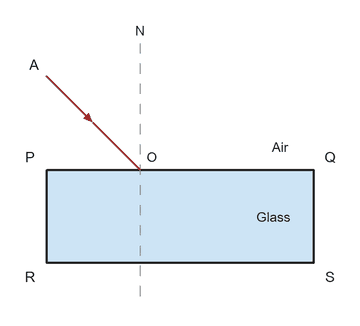
Answer: (B) (1) and (4)
Concept: A ray crossing a parallel-sided glass slab is refracted twice: towards the normal on entering (air to glass) and away from the normal on leaving (glass to air). Because the two faces are parallel, the angle of emergence e equals the angle of incidence i, so the emergent ray is parallel to the incident ray, only shifted sideways (lateral displacement).
Step 1 — At the top face (air to glass).
Light slows down on entering glass, so the refracted ray bends towards the normal. Statement 1 is correct and statement 2 is wrong.
Step 2 — At the bottom face (glass to air).
Light speeds up on leaving glass, so the emergent ray bends away from the normal. Statement 4 is correct and statement 3 is wrong.
Step 3 — See the result.
Since the faces are parallel, the emergent ray comes out parallel to AO, shifted sideways.
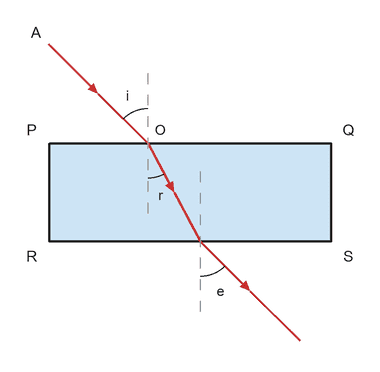
Watch out: The two bends are opposite: towards the normal going in, away from the normal coming out.
Why the other options are wrong:
- (A) (1) and (3): statement 3 is wrong: a ray going from glass into air bends away from the normal, not towards it.
- (C) (2) and (3): statement 2 is wrong (entering glass the ray bends towards the normal), and statement 3 is wrong too.
- (D) (2) and (4): statement 2 is wrong: entering glass from air, the ray bends towards the normal.
Therefore, statements 1 and 4 are correct, option (B).