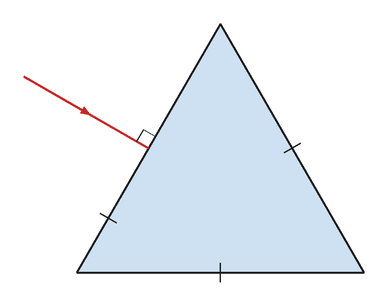
Solution:
Concept: A ray along the normal enters the glass without bending. A prism refracts a ray twice, at two faces inclined at the angle of the prism A. Inside, the angles of refraction at the two faces add up to A (r₁ + r₂ = A); the total turning of the ray is the angle of deviation (δ = i₁ + i₂ − A), where i₁ is the angle of incidence and i₂ the angle of emergence.
(a) Angle of incidence on the first face
Step 1 — Normal incidence.
The ray falls normally, that is, along the normal, so the angle of incidence is 0°.
(b) Angle of refraction from the first face
Step 2 — No bending.
With i = 0° the ray goes straight in without bending, so r₁ is 0°.
(c) Angle of incidence at the second face
Step 3 — Use r₁ + r₂ = A.
The angle of an equilateral prism is 60°.
r2=A−r1=60∘−0∘=60∘
(d) Minimum deviation?
Step 4 — Compare with the symmetric path.
At minimum deviation the path is symmetric (r₁ and r₂ each 30°, ray parallel to the base). Here r₁ is 0° and r₂ is 60°, so the path is not symmetric: no.
Step 5 — What really happens.
60° is more than the critical angle of glass (about 42°), so the ray is totally internally reflected at the second face and leaves through the base.
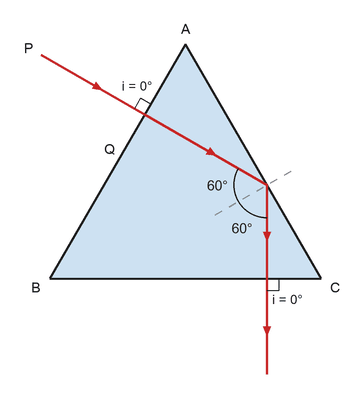
Therefore, (a) 0°, (b) 0°, (c) 60°, and (d) no, the ray does not suffer minimum deviation.