
Question 151 markMCQEasy
With respect to light passing from air into water, which of the following statements is correct ?
Confirming your payment
Sign up now and get 250 free tokens.
Refraction of Light at Plane Surfaces · Question 15 of 139
With respect to light passing from air into water, which of the following statements is correct ?
(A) Angle of incidence is equal to the angle of refraction
(B) Angle of incidence is always greater than the angle of refraction
(C) Angle of incidence is always less than the angle of refraction
(D) Angle of incidence has no effect on the angle of refraction.
Answer: (B) Angle of incidence is always greater than the angle of refraction
Concept: Snell's law: for light going from medium 1 into medium 2, sin i ÷ sin r = ₁μ₂, a constant called the refractive index of medium 2 with respect to medium 1. Here i is the angle of incidence and r the angle of refraction, both measured from the normal. For air to water, = 4/3.
Step 1 — Write Snell's law for air to water.
Rearranging Snell's law gives the sine of the angle of refraction.
Step 2 — Compare r with i.
Dividing by 4/3 (more than 1) makes sin r smaller than sin i, so r is smaller than i for every oblique ray. For example, i = 50° gives r ≈ 35°. At normal incidence both are 0°.
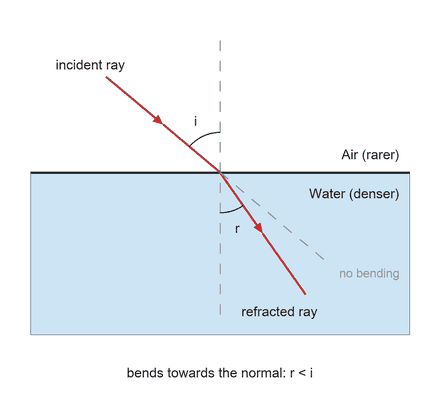
Watch out: "always" here means for every oblique ray; at normal incidence both angles are zero.
Why the other options are wrong:
Therefore, the angle of incidence is always greater than the angle of refraction, option (B).