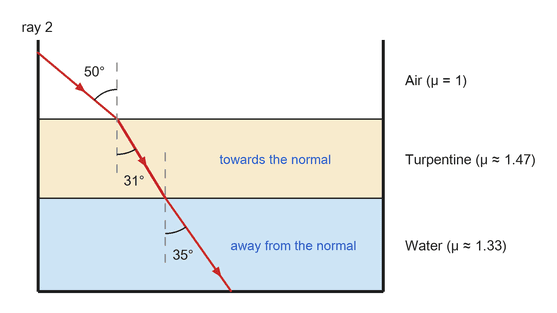
Answer: (B) Ray 2
Concept: Bending depends on optical density (refractive index), not on mass density. Turpentine floats on water because it is lighter, but it is optically denser: air (μ = 1) < water (about 1.33) < turpentine (about 1.47).
Step 1 — Air to turpentine.
This is rarer to denser, so the ray must bend towards the normal.
Step 2 — Turpentine to water.
Water is optically rarer than turpentine, so the ray must bend away from the normal.
Step 3 — Compare with air.
Water is still denser than air, so in water the ray is nearer the normal than it was in air. For a ray at 50° in air (an example), it makes about 31° in turpentine and about 35° in water.
Step 4 — Pick the ray.
Only ray 2 bends towards the normal in turpentine and then away from it in water, ending between its two earlier directions.
Watch out: Turpentine floats on water but is optically denser; mass density does not decide the bending.
Why the other options are wrong:
- (A) Ray 1: ray 1 bends towards the normal again in water, as if water were optically denser than turpentine.
- (C) Ray 3: ray 3 does not bend at either surface, although it meets both surfaces obliquely.
- (D) Ray 4: ray 4 bends to the wrong side at the turpentine surface, away from the normal, while a ray entering a denser medium must bend towards the normal.
Therefore, ray 2 shows the correct path, option (B).

