
Question 892 marksEasy
An object placed in one medium when seen from the other medium, appears to be vertically shifted. Name two factors on which the magnitude of the shift depends and state how does it depend on them.
Confirming your payment
Sign up now and get 250 free tokens.
Refraction of Light at Plane Surfaces · Question 89 of 139
An object placed in one medium when seen from the other medium, appears to be vertically shifted. Name two factors on which the magnitude of the shift depends and state how does it depend on them.
Solution:
Concept: An object inside a denser medium, seen from the rarer medium (air) along the normal, appears raised: light from it bends away from the normal on leaving, and the eye traces the rays straight back. For viewing from vertically above, μ = real depth ÷ apparent depth. The object appears raised by the shift (real depth − apparent depth), which works out as t(1 − 1/μ) for real depth t.
Step 1 — Factor 1: thickness (depth) of the medium t.
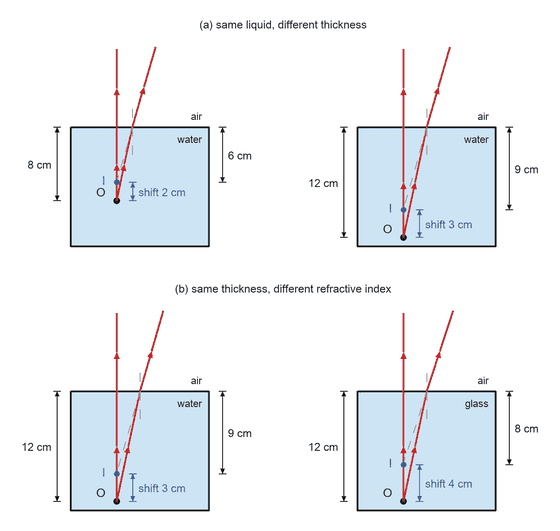
The shift t(1 − 1/μ) is directly proportional to t: the deeper the object, the larger the shift. In water, an object 8 cm deep is raised by 2 cm, but one 12 cm deep by 3 cm.
Step 2 — Factor 2: refractive index μ.
The higher the refractive index, the larger the shift. For the same 12 cm, the shift is 3 cm in water (μ of 4/3) but 4 cm in glass (μ of 1.5).
Step 3 — A related factor.
μ depends on the colour (wavelength) of light, so the shift is larger for violet light than for red light.
Therefore, the shift increases with the thickness of the medium and with its refractive index.