
Question 1051 markMCQEasy
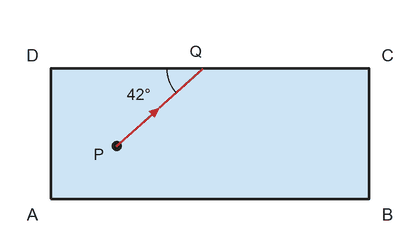
The diagram below shows a light source P embedded in a rectangular glass block ABCD of critical angle . The ray PQ would :
Confirming your payment
Sign up now and get 250 free tokens.
Refraction of Light at Plane Surfaces · Question 105 of 139
The diagram below shows a light source P embedded in a rectangular glass block ABCD of critical angle . The ray PQ would :
(A) pass undeviated
(B) suffer refraction
(C) suffer reflection
(D) suffer total internal reflection
Answer: (D) suffer total internal reflection
Concept: Total internal reflection happens when light goes from a denser to a rarer medium and meets the surface at an angle of incidence greater than the critical angle. Then no light is refracted out: all of it is reflected back into the denser medium, obeying the laws of reflection. Angles of incidence and refraction are measured from the normal, never from the surface.
Step 1 — Find the angle of incidence at Q.
PQ makes 42° with the surface DC, so its angle with the normal is
Step 2 — Compare with the critical angle.
The ray goes from glass (denser) to air (rarer), and 48° is more than the critical angle 42°. Both conditions hold, so PQ is totally internally reflected at Q.
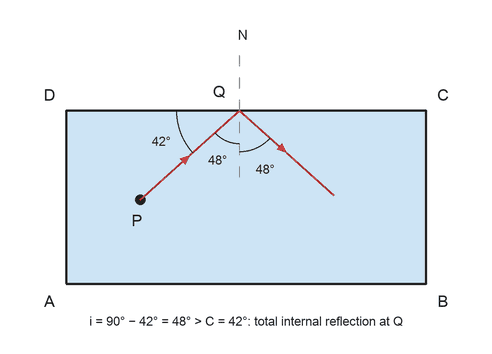
Watch out: The 42° in the figure is the angle with the surface, not the angle of incidence.
Why the other options are wrong:
Therefore, PQ suffers total internal reflection, option (D).