
Question 1041 markMCQEasy
Which of the following figures will depict deviation of ray of light A through

Confirming your payment
Sign up now and get 250 free tokens.
Refraction of Light at Plane Surfaces · Question 104 of 139
Which of the following figures will depict deviation of ray of light A through
(A) (a)
(B) (b)
(C) (c)
(D) (d)
Answer: (D) (d)
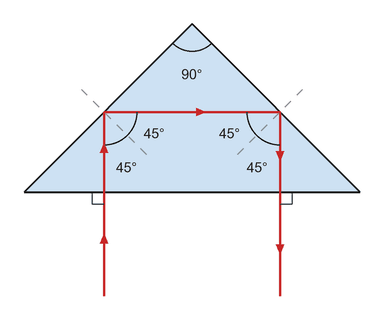
Concept: A total reflecting prism is a glass prism whose principal section is a right-angled isosceles triangle (90°, 45°, 45°). Light entering a face normally goes in without bending and meets the next face at 45°, which is more than the critical angle of glass (42°), so it is totally reflected there.
Step 1 — Figure (d).
In figure (d) the ray enters the hypotenuse along the normal, without bending.
Step 2 — Two reflections.
It meets each short face at 45°, more than the critical angle of glass (42°), so it is totally reflected at both faces, turning 90° each time.
Step 3 — Result.
It comes out through the hypotenuse travelling back the way it came: a deviation of 180°. This arrangement is used in binoculars.
Why the other options are wrong:
Therefore, figure (d) shows a deviation of 180°, option (D).