
Question 1031 markMCQEasy
An equilateral prism can be used to deviate a ray of light through :
Confirming your payment
Sign up now and get 250 free tokens.
Refraction of Light at Plane Surfaces · Question 103 of 139
An equilateral prism can be used to deviate a ray of light through :
(A)
(B)
(C)
(D)
Answer: (B)
Concept: Total internal reflection happens when light goes from a denser to a rarer medium and meets the surface at an angle of incidence greater than the critical angle. Then no light is refracted out: all of it is reflected back into the denser medium, obeying the laws of reflection. A prism refracts a ray twice, at two faces inclined at the angle of the prism A. Inside, the angles of refraction at the two faces add up to A (r₁ + r₂ = A); the total turning of the ray is the angle of deviation (δ = i₁ + i₂ − A), where i₁ is the angle of incidence and i₂ the angle of emergence. Both bends turn the ray towards the base of the prism.
Step 1 — Send the ray in normally.
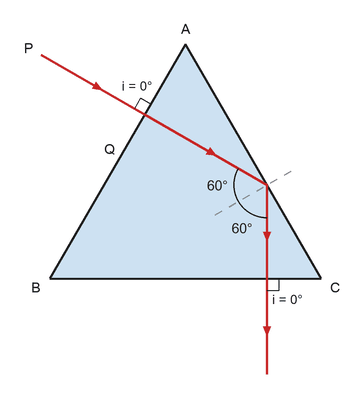
A ray falling normally on face AB of an equilateral prism goes straight in.
Step 2 — At the second face.
Since r₁ + r₂ is 60° and r₁ is 0°, the ray meets face AC at 60°. This is more than 42°, so the ray is totally reflected. A reflection at 60° turns the ray through
Step 3 — At the third face.
The reflected ray meets the base BC along its normal and leaves without bending. So the total deviation is 60°.
Why the other options are wrong:
Therefore, an equilateral prism can deviate a ray through 60°, option (B).