
Question 61 markMCQEasy
In refraction of light, the relation between incident angle and refracted angle is :
Confirming your payment
Sign up now and get 250 free tokens.
Refraction of Light at Plane Surfaces · Question 6 of 139
In refraction of light, the relation between incident angle and refracted angle is :
(A)
(B)
(C)
(D) there is no fixed relation
Answer: (D) there is no fixed relation
Concept: Refraction is the change in direction of light when it passes obliquely from one transparent medium into another. It happens because light travels at different speeds in different media. Light bends towards the normal when it enters an optically denser medium (it slows down) and away from the normal when it enters an optically rarer medium (it speeds up). All angles are measured from the normal, the line at 90° to the surface at the point of incidence.
Step 1 — Light going from rarer to denser.
From air into glass the ray bends towards the normal, so i > r. For example, i = 50° gives r ≈ 30.7°.
Step 2 — Light going from denser to rarer.
From glass into air the ray bends away from the normal, so r > i. For example, i = 30° gives r ≈ 48.6°.
Step 3 — Light along the normal.
At normal incidence both angles are 0°, so neither is bigger.
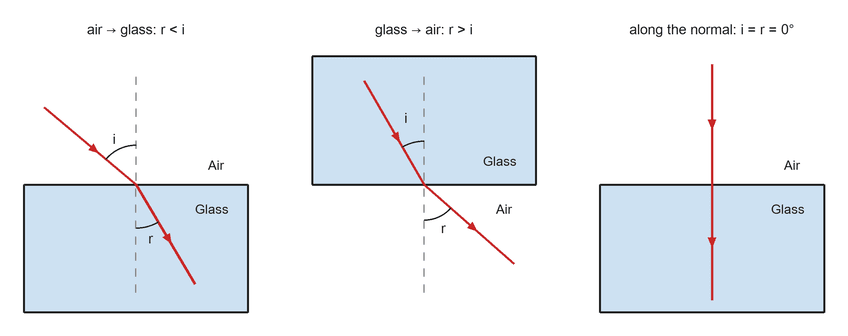
Step 4 — Conclude.
Which angle is bigger depends on the direction of travel, so there is no single fixed relation between i and r.
Watch out: Do not learn "i > r" as a rule; it holds only when light enters a denser medium.
Why the other options are wrong:
Therefore, there is no fixed relation between i and r, option (D).