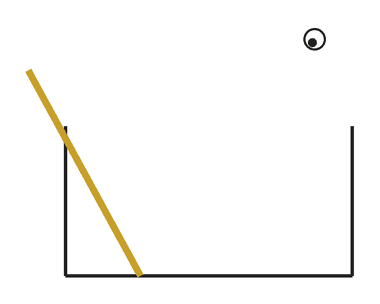
Solution:
Concept: Once water is poured in, light from the immersed part of the pencil reaches the eye by passing from water into air, so that part appears raised.
(i) Change observed
Step 1 — Describe the change.
The part of the pencil under water appears raised and shorter, so the pencil appears bent at the water surface. Its tip appears higher than its real position.
(ii) Phenomenon
Step 2 — Name it.
Refraction of light: light from the immersed part bends away from the normal as it passes from water (denser) into air (rarer).
(iii) Completed diagram
Step 3 — Draw the rays.
Draw two rays from the tip of the pencil up to the water surface, close together. At the surface each bends away from the normal and goes on to the eye.
Step 4 — Find the image.
Produce the two emergent rays backward (dotted); they meet above the real tip. Join this image to the point where the pencil meets the water surface: this is the apparent position of the immersed part.
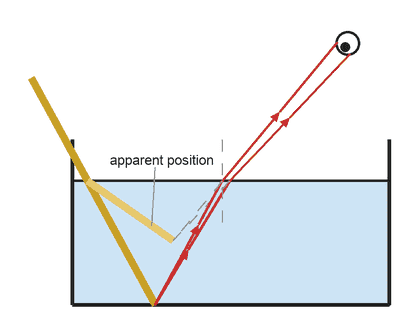
Therefore, the pencil appears bent and raised at the water surface, due to refraction of light.